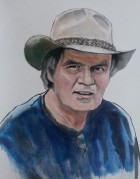

A 61-year-old Edmonton man who spent more than half his life behind bars is now free.
In 1991, a jury found Roy Sobotiak guilty of second-degree murder in the disappearance of his former babysitter, Susan [Susie] Kaminsky.
Sobotiak, 27 at the time, was given a life sentence with no chance of parole for 16 and a half years. He was repeatedly denied parole, even after he had been in the joint for 30 years. His door to partial freedom was slammed shut every time.
In late February 2025, things began to change. That’s when the Federal Minister of Justice, a Liberal, ruled that Sobotiak’s murder trial was unfair. He said Roy Sobotiak should get a new trial.
So what was unfair about Sobotiak’s trial? The Minister of Justice pointed out that key evidence had been withheld. Maybe so. A statement that his mother, Donalda, gave police was suppressed at trial. According to Sobotiak, his mother told police that Susie Kaminsky was around to her house AFTER police claimed she was dead.
Further, she says, when Susie was at her house, she was with another man. That’s … ahem … critical evidence. One would think the jury would have heard this, but it didn’t.
Sobotiak says two more people had evidence that contradicted the official police narrative — but the jury never got to hear that either.
In late July 2025, Roy Sobotiak’s murder conviction was ‘stayed.’ In other words, tossed. Sobotiak is now a free man without restrictions.
It was February 1987 when 34-year-old Susan [Susie] Kaminsky of Edmonton suddenly vanished. Following a police ‘sting’ operation, her friend Roy Sobotiak was charged with Kaminsky’s murder, even though her remains hadn’t been located.
The police theory was that Sobotiak dismembered his victim in the bathtub of his downtown apartment, stuffed the remains in garbage bags and tossed them in a dumpster. Officers believe that body parts would have ended up in a large dump northeast of the city. Detectives say they searched the area but failed to find anything. One detective remarked, “Have you ever been to the dump? It’s huge!”
It’s worth noting that no blood was found in Sobotiak’s bathtub.
Sobotiiak has a much different account of events. He says he was warned by a police informant that harm would come to his family if he didn’t cooperate with officers, and so he fabricated a story about killing and dismembering Susie. He said the gruesome details came from a movie called “Ms. 45.” [also known as ‘Angel of Vengeance’].
Sobotiak says he can’t remember if he had sex with his former babysitter because he was high on a combination of drugs and alcohol and therefore couldn’t get an erection anyway.
According to Sobotiak, Susie told his mother she wanted to move to Vancouver to get away from a jealous and abusive ex-partner.
At trial, police released portions of a video — recorded secretly in a room at the Chateau Louis Hotel in north-central Edmonton — where Sobotiak supposedly fessed up. It was a sting operation where undercover officers — pretending to be drug bosses — tried to recruit Sobotiak.
Detectives plied Sobotiak, a drug user himself, with so much booze that he could barely make his way to the washroom. Put it this way, if the suspect had been given a breathalyzer, he would’ve blown every gasket in the machine.
Sobotiak points out that close scrutiny of the video will show that police were effectively coaching him on what to say.

Roy Sobotiak at the Edmonton Institution in October 1991 [Photo by Author}
For three and a half decades, Sobotiak has bounced around penitentiaries in Alberta, Saskatchewan, Manitoba and British Columbia, always maintaining his innocence. He describes his years of incarceration as physical and mental torture — by the staff of Correctional Services Canada. Fellow prisoners weren’t always nice either. A number of times, he says, cons did “hits” on behalf of staff. “How does a prisoner?” he asks, “gain access to a pair of brass knuckles?”
“The good guys are treated like shit,” Sobotiak adds, “and the bad guys are generally allowed to run amuck.”
Sobotiak says he was struggling with post-traumatic stress disorder [PTSD].when he was charged after watching an intoxicated friend [Dave Peters] fatally shoot himself in the head with a .357 magnum. “Being in the joint,”;he adds, “further traumatized me.”
He also said the Parole Board uses ‘blackmail’ tactics because inmates don’t stand a chance unless they confess.
And where are these arrogant Parole Board members today? Have they reached out to Sobotiak to say, “Sorry, we fucked up”? Not likely; political hacks aren’t known for their integrity.
The Federal Minister of Justice, Arif Virani, did not indicate publicly why Sobotiak should get a new trial, nor is he required to do so.
Sobotiak’s case attracted the attention of Toronto-based Innocence Canada, which advocates on behalf of people who may have been wrongfully convicted. A senior lawyer with the non-profit group, James Lockyer, was in an Edmonton courtroom today fighting for Sobotiak’s release.
Sobotiak appeared in court in prison garb — an orange jumpsuit — and before Justice Eric Macklin entered the courtroom, the prisoner had a private talk with Lockyer and the head of Innocence Canada, Win Wahrer.

I did not recognize Sobotiak when I first saw him in court a few weeks ago, and I suspect he didn’t recognize me. It had been a while. We last met in 1993 at the Edmonton Max.
Initially, the Crown had opposed bail, pointing out that Sobotiak’s appeal had already been tossed by a higher court. The Crown then changed its tune. It said it no longer opposed bail — but wanted Sobotiak placed under ‘house arrest.’
Lockyer began his submission by pointing out that Roy Sobotiak is Canada’s longest-serving prisoner [for wrongful conviction]. He added that when he met Sobotiak, he was impressed with his “lack of bitterness.”
The lead lawyer for Innocence Canada opposed house arrest, arguing that it only substituted one prison for another. Part of the “trade-off” was that the former prisoner must attach a GPS tracking device to his ankle for the next three months.
Sobotiak refers to the device as “government-issued jewellery.”
Justice Macklin decided to release Sobotiak, and he wanted it done pronto. He, too, rejected the idea of house arrest.
This will go down as yet another wrongful murder conviction in Canada. There’s been a pile of them and we wonder why many think of our judicial system as little more than a roll of the dice. That’s not the way it’s supposed to be.
Sobotiak is being moved to Ross Residence, a private recovery facility in Fort McMurray in Northern Alberta. One of the conditions is that he must obey a curfew and, as mentioned, wear an ankle bracelet for the next three months.
Meanwhile, the Edmonton man is adamant that he didn’t kill Susan Kaminsky.
The Author takes no position on his guilt or innocence.
Sobotiak, described by a fellow inmate as a “pill-popper,” says his goal is to clean up, land work as an industrial painter, and get on with his life. He’ll need more than luck to succeed because much of the world has changed since a jury found him guilty and he was led away in handcuffs.
In his closing argument, Lockyer said Roy Sobotiak has been behind bars for a very long time, pointing out that one of the lawyers in the courtroom was only four years old when he was incarcerated.
A quote attributed to Roy Sobotiak: “I always knew this would happen someday, that I would get justice.”
Just before Justice Macklin left the courtroom, he turned towards the man standing in the prisoner’s box and said, “Good luck to you.”
Sobotiak will have his work cut out for him. Former CBC Radio tech David Dawkins — who was handling news reports on Sobotiak when the man was charged decades ago — put it this way: “It is like something out of The Twilight Zone. A man enters a time machine … he cannot get out … and when the machine pops open, almost 36 years have passed.”
Dawkins points out that Roy Sobotiak has no working knowledge of smartphones, Google, Dick Tracy wristwatches, electric cars, gaming consoles, computers … even ankle bracelets. “It will be like entering a funhouse for the first few months,” he says, adding, with a hint of caution, “the constant feeling of change and upheaval may be difficult to live with.”
STORY UPDATE … with the help of Win Wahrer and Innocence Canada, Sobotiak is settling into his new digs in Fort McMurray. He was given new clothes, a cell phone and toiletries … plus a haircut. But that only lasted a few months. In late September 2025, Sobotiak picked up his possessions from the group home, left Fort McMurray, and headed to Edmonton. At last report, he was staying with a friend in the city.


Very nice, too bad Sobotiak is not FREE after all those years but at least maybe it’s a start.
Great job on the write-up. Hope you are well and by your writing, it sounds like it.
LikeLike