I’ve FINALLY written my autobiography … it’s called “A Dog in the Forest and Other Discoveries.”
The 619-page paperback, now available on Amazon, has 77 chapters.
Yes, finally!! I lost track of the number of people who were on my case to get this done. After a near-fatal brush with blood poisoning last year, I figured the time was right.
And so … I began writing. Once I got started, I couldn’t stop. Day after day, I worked late into the night; then got up early and, after two cups of coffee, sometimes three, I wrote more …
[Read Time: 30 minutes]
Australian Media …
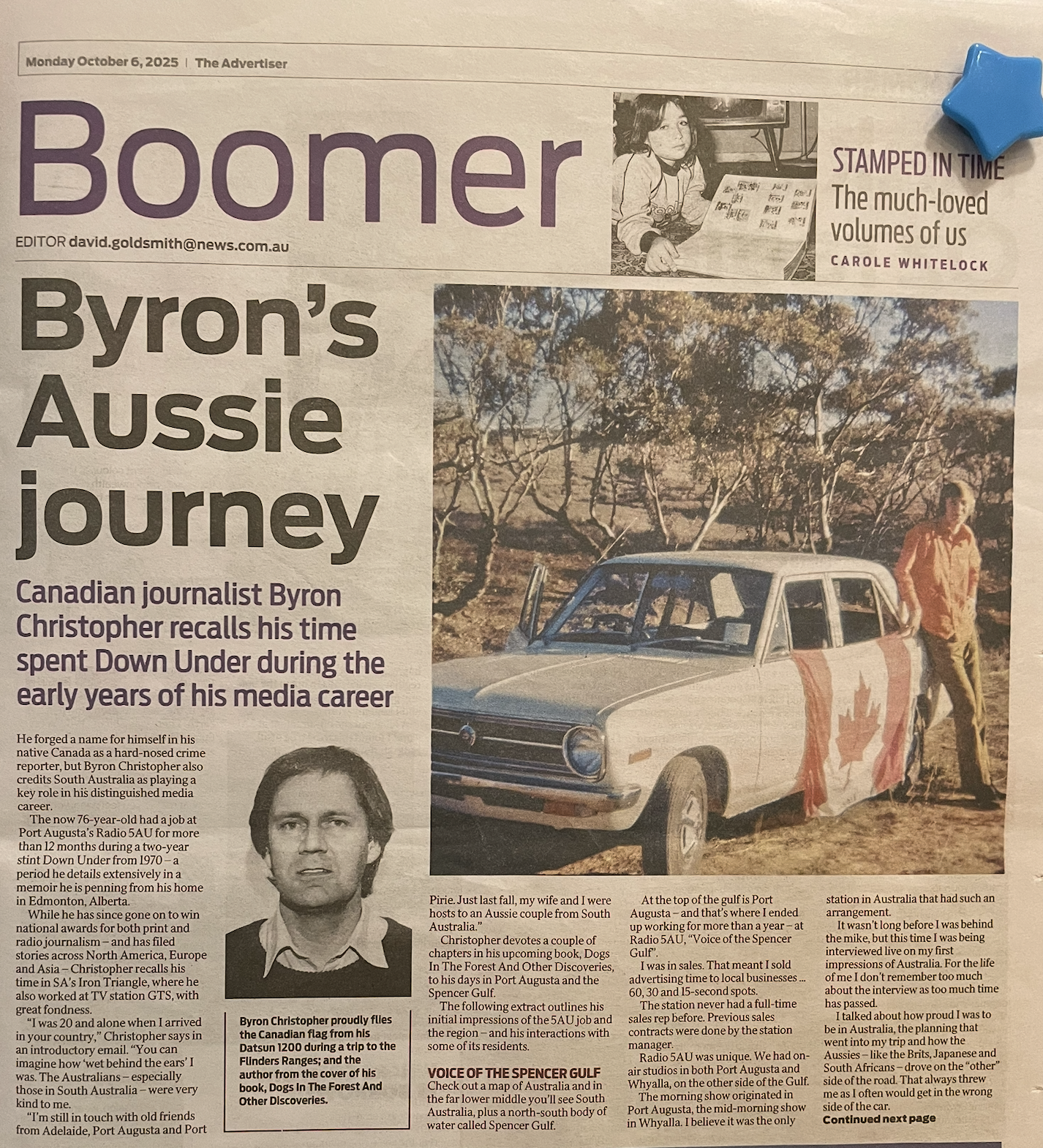
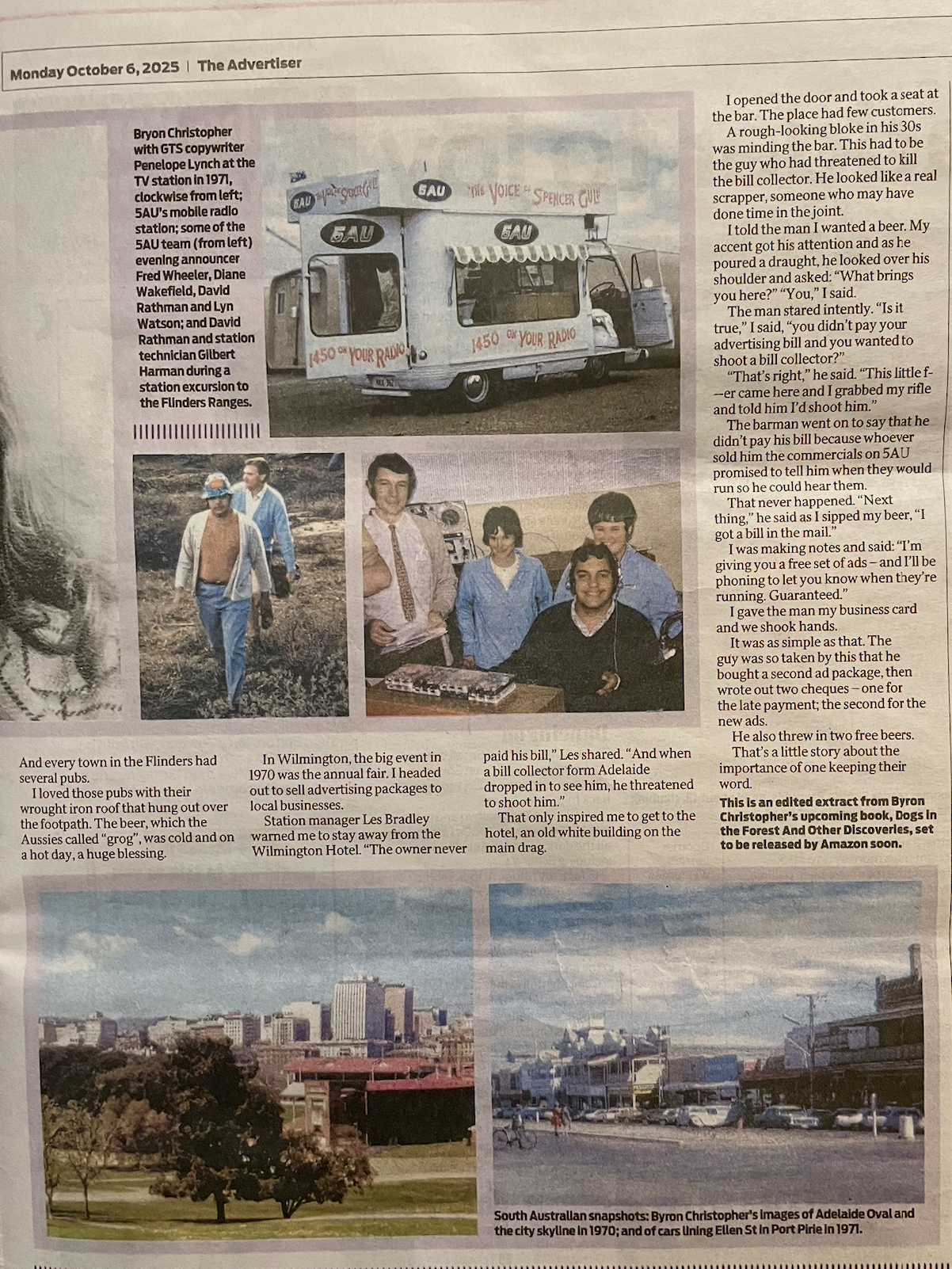
On October 7, 2025, The Adelaide Advertiser — one of the largest newspapers Down Under — published a feature story on the book, focusing on my time in South Australia from 1970-72.
For the attached screen captures, I thank Margaret Muller of Adelaide for a] buying the newspaper, b] attaching pages to her fridge and c] snapping photos. Keep in mind that Margaret and I are both seniors, and this is all high-tech stuff. Those who grew up with typewriters will understand.
Here’s the write-up from the Aussie paper … click on the image to make it larger.

There was also an interview about the book on CKNB Radio in Campbellton, NB, on September 30, 2025.
The paperback goes for $20 Cdn. The print size is large [or at least not tiny]. So it’s easier to read.
Click on the link below to check out the cover — and to order a copy. I chose a bright colour for the cover, so if you misplace the book, you’ll be able to spot it half a block away.
The book is available in English in 14 countries [Canada, US, UK, Germany, France, Italy, Spain, Australia, Poland, Sweden, Belgium, Ireland and Japan]. In some countries, you can also get it in hardcover. Unfortunately, Canada isn’t one of them.
ARTIFICIAL INTELLIGENCE SUMMARIES
The following are condensed versions of the chapters — as created by “Artificial Intelligence” [AI]. In other words, here’s what a computer has to say about the chapters in this book. Oh, and this time, these are accurate.
PROLOGUE – This book recounts the Author’s seven decades on this planet, highlighting how experiences and assignments shaped his perspective. He reflects on the evolution of journalism, noting a decline in trust and an increase in government influence. The Author also questions the independence of the media, citing examples of censorship, selective reporting, and government funding.
ABOUT THE AUTHOR – The Author recounts his career in news broadcasting, spanning mainstream and independent media. He highlights his experience in radio and television across Canada and Australia, including investigative journalism and breaking major news stories.
DEDICATION – The Author dedicates the book to Larry Travis, Nancy Tyler, and Fiona Lamplugh, highlighting a chance reunion sparked by a shared interest in a blog post. He expresses gratitude to those who contributed to the book and emphasizes the importance of honest and transparent reporting, drawing inspiration from Ben Bagdikian’s advice to prioritize the public’s interest.
1 – MEMORY LANE – This autobiography reflects on the Author’s life and reporting career, highlighting experiences that shaped them. The Author, now 76, acknowledges the urgency of writing due to health concerns and a near-death experience with sepsis in 2024. Writing the book serves as physical and mental rehabilitation.
2 – WE ALL COME FROM SOMEWHERE – The Author reminisces about growing up in Campbellton, New Brunswick, highlighting childhood adventures, family history, and the influence of pen-pals. The Author’s father, a railway labourer, musician, and WWII medic, is remembered for his kindness and the impact he had on the community. The author emphasizes the importance of preserving personal stories to avoid the unknown fate of his grandfather, John. The Author reflects on his family’s legacy and the lasting impression of his hometown, while acknowledging the challenges and imperfections of life.
3 – MY FIRST DISCOVERY – At four years of age, the Author embarked on a solo journey, discovering a breathtaking view and later, a dog abandoned in the woods. This traumatic experience shattered his naivety and inspired a lifelong commitment to compassion and journalism.
4 – KIDS WILL BE KIDS – The Author reminisced about life in the 1950s and 60s, highlighting simple joys like going to the movies and playing sports. Despite the lack of modern technology, the author recalled fond memories of family meals and community gatherings. The Author also shares a harrowing near-death experience on an ice floe and the camaraderie of playing road hockey in the snow.
5 – EARLY JOBS & CONNECTIONS – It was the summer of 1966, and thanks in large part to his father’s influence, the Author landed a summer job with Canadian National Railways. His hiring was a case of “it’s not what you know, but who you know.”
6 – FLOWERS MAKE GREAT BRIDGES – The Author reflects on two memorable teachers from their high school days: Jean Olscamp, a history teacher who inspired a love for travel, and Genevieve Ethier, a typing teacher. Jean tragically passed away in a car accident, leaving a lasting impact on the author. Genevieve, who later became a close friend, shared a tragic story of losing her brothers in a drowning accident, shedding light on her strict demeanour as a teacher.
7 – DIRTY SECRETS – The Author reflects on the limited information provided in high school, highlighting the importance of critical thinking and practical skills. While acknowledging the value of a high school education, he questions the absence of crucial topics such as historical truths, financial literacy, and life skills. Despite the challenges, the Author and classmates navigated life, finding success in various fields.
8 – THE SPEED DEMONS – The Speed Demons, a church-based indoor soccer team in Campbellton, was known for its democratic approach and strong sense of community. Led by coach Don Hume, the team emphasized teamwork and sportsmanship, winning numerous championships and fostering a sense of pride among its players. The team’s legacy continues to inspire, highlighting the positive impact of sports on young lives.
9 – FIRST TIME ON THE AIR – In the 1960s, the Author, a young hockey fan, began a career in radio broadcasting in Campbellton, inspired by local station CKNB and legendary hockey broadcaster Peter Maher. The Author started by providing sports updates and eventually became a regular sportscaster. He reflects on the impact of radio on his life, from listening to CBC coverage of the Springhill mining disaster to following in Maher’s footsteps as a sports journalist.
10 – GETTING PAID TO PLAY RECORDS?? – The Author recounts his first job as a DJ at CKMR Radio in Newcastle, New Brunswick. He describes his nervous first shift, the challenges of the job, and the support he received from colleagues. He also shares a memorable encounter with a nun on a train, highlighting the impact of kindness and empathy. In the 1960s and 70s, radio stations were known for their wild antics, especially among DJs.
These pranks, often harmless, were seen as a way to maintain good spirits. While some incidents, like a DJ faking a shooting, were more serious, most were light-hearted, such as the time the Author was ambushed with paper clips while reading the news with a wastepaper basket over his head. He recounted his time at CKMR, highlighting both the joys and challenges of the job. He also shared stories of fatal car accidents he covered, the impact of low pay on his life, and the camaraderie among staff. The Author also reflects on the evolution of the radio industry, the importance of local news, and the impact of technology on broadcasting.
11 – WHY I LOVE PEEPHOLES – In 1969, the Author, a radio host in Quebec City, was robbed at knifepoint. He managed to disarm the intruders by revealing a derringer, though it was unloaded. The incident highlights the challenges faced by the Author at CFOM, including equipment malfunctions and a lack of security measures. The Author recounts his experiences at the only English radio station in Quebec City, highlighting both the challenges and memorable moments. He mentions the station’s cost-cutting measures, including a lack of first-aid kits and subpar equipment, as well as a threat from the FLQ. He also reflects on the station’s journalists, including Bill Kokesch, whose later conviction for child pornography shocked the Author and the media.
12 – BC IN BC – In 1969, the Author, aiming to reach Australia, worked as an evening DJ and TV newsreader at CJDC Radio-Television in Dawson Creek, British Columbia. While there, he experienced humorous moments, like Australia falling off the TV news map — and challenging situations, including a gunman attacking the main studio. Despite the occasional mishap and the unorthodox nature of the news business, the Author found the experience valuable and memorable. He remembers fabricating a TV weather forecast and his relationship with his girlfriend, Lori. The Author reflects on his departure from CJDC, embarking on a journey to Australia, and the impact Lori had on their life, including her support many years later during his illness and her eventual passing.
13 – THE RAILWAY STATION – A woman in Dawson Creek, grieving the loss of her son in the 1940s, believed he would return and so she walked to the train station daily for 25 years. Her tragic story is a testament to the enduring pain of war.
14 – CLICK! OH NO, NOT AGAIN! – During a layover in Honolulu, the Author recounts a series of events, including a close call with a gunman, a chance encounter with a radio DJ, and a selfless act of kindness towards a young student. He reflects on the stranger’s fate and the impact of their brief encounter.
15 – LIVING DOWN UNDER – The Author recounts his fascination with Australia, leading him to pursue a career in broadcasting there. After arriving in Sydney, he secured a job handling diamonds at Diamond Bort, a company that produced drilling bits for the oil industry. Despite initial challenges and cultural differences, the Author became increasingly settled in Australia, cherishing his newfound independence and the unique experiences he encountered. He recalls his first experience living abroad. He befriended several people, including George, a native of Egypt who legally changed his name to Kennedy, and Helen, a
high school student who later became a lawyer and judge. The Author also shares stories about John, a Welshman who introduced him to 35 mm cameras, and Lorna, Helen’s mother, who remembered the Author’s childhood dreams from years ago. Helen and the Author attended a concert at the partially-finished Opera House in 1971.
16 – VOICE OF THE SPENCER GULF – The Author recounts his time working at Radio 5AU in Port Augusta, South Australia. He describes the unique station setup with studios in both Port Augusta and Whyalla, and his experiences selling radio advertising and interacting with clients. He shares anecdotes about exploring the Flinders Ranges, encountering wildlife, and building trust with clients through honesty and reliability. The Author recalls his encounters with dangerous wildlife such as poisonous snakes and spiders.
He also shares stories about the country’s unique currency system, the heat in Port Augusta, and his work at Radio 5AU. The Author reflects on the changes in the radio industry and pays respects to old friends during a return visit.
17 – THE MYSTERY BAND – In 1971, the Author discovered a local band in Port Pirie, South Australia, and gave them their first radio broadcast. The band, whose name the author has forgotten, later achieved success and treated the author to a meal. The Author’s search for the band members in 2025 yielded no results, but discovers the band’s lead singer may have been the late Brian Sayner of the Globrites.
18 – PORT PIRIE AND GTS TV – The Author recounts his time in Port Pirie, South Australia, highlighting the down-to-earth nature of the people he met. He specifically mentions Ken Madigan, a former athlete and mayor known for his bravery in convincing a gunman to surrender and his dedication to preserving war memorials.
The Author also shares a humorous anecdote about interviewing Ian Chappell, a famous cricketer, and his experiences working at GTS Television in Port Pirie, highlighting both positive and negative aspects. He describes a memorable argument with a colleague, a chaotic party, and a road trip to Sydney with a hitchhiker who had been a mental hospital patient. He also shares brief encounters in Sydney with friends George and Helen and a night spent on a beach in Cape Byron.
19 – LEAVING SOUTH AND WEST AUSTRALIA – Leaving South Australia, the Author recalls a deadly shark attack in Port Augusta, highlighting the country’s dangerous wildlife. Travelling to Perth, he picked up a hitchhiking couple, experiencing a humorous incident over miles travelled … with a warning about snakes crawling into sleeping bags. In Perth, he found work on a construction site, narrowly avoiding a fatal fall, and received a touching Christmas phone call from his family in Canada.
20 – AFRICA: HELLO & GOODBYE – The Author and his girlfriend left Australia on a cruise to South Africa, planning to work and travel through Africa and Europe. Their arrival in South Africa was challenging, with the Author initially denied entry. Despite job offers in Johannesburg, the couple left South Africa after witnessing police brutality and decided to continue their journey to Victoria Falls in Rhodesia (now Zimbabwe). While travelling in Rhodesia, the Author fell ill after drinking non-potable water at Victoria Falls. Hospitalized, he was offered a mercenary job guarding a dam under construction in Mozambique, but was warned of the risks. With dwindling funds, he received a loan from his sister in Montreal and continued his journey to Northern Europe.
21 – EUROPE – In 1972, the Author travelled through Europe, starting in Athens, Greece. He experienced the local culture, including bargaining for souvenirs and marvelling at ancient ruins such as the Parthenon.
The journey continued by train through Yugoslavia, Austria, and Germany, with memorable stops in Belgrade and Munich, before reaching Stockholm, Sweden.
22 – SUOMI – Also in 1972, the Author travelled to Finland with his girlfriend, where he faced language barriers and cultural differences. Despite initial challenges, he immersed himself in Finnish life, working on a farm and a shipbuilding company — plus learning the language and experiencing Finnish traditions such as saunas. He also learned about Finland’s history, including its struggle for independence and its role in World War II.
23 – GREEN HELMET – In 1972, the Author worked as a dockworker at Wärtsilä, a large shipbuilding company in Turku, Finland. Despite the challenging language barrier and monotonous work, he found the experience rewarding, gaining a new perspective on immigrant labour. The Author recounts daily life, interactions with colleagues, and significant events such as the Munich Olympics Massacre and the Canada-USSR hockey series.
The Author recounts his experience working on a cargo ship in Finland, including a humorous incident involving vodka prices and a harrowing task of removing debris from a cramped, dark space beneath the ship’s keel. Despite the challenges, the Author found the work rewarding and reflects on the ship’s long history and eventual decommissioning.
24 – TOURISTS IN FINLAND – The Author recounts his time living in Finland, highlighting the country’s creativity, workmanship, and natural beauty. He mentions visiting Helsinki, the Sibelius monument, and experiencing Finnish traditions such as saunas and ‘lake jumping.’ The Author also reflects on the cultural differences he noticed upon returning to Canada.
25 – BACK IN CANADA – The Author and Hardis returned to Canada after living abroad for three years. They settled in Toronto, found jobs, and started a family. Despite facing challenges — like a slight accent and financial pressures — they built a life together, raising two daughters and cherishing their experiences in their new home. The Author recounts life in Ontario, including failed job interviews at CBC Radio in Thunder Bay and Ottawa. He highlights encounters with individuals like Wayne Morrison, who warned him about a former colleague’s mob connections, sharing insights into the drug trade. The Author also shares a humorous yet dangerous incident involving a neighbour’s balcony and a missed opportunity to buy a condo due to financial constraints.
26 – CANADA’S CONSCIENCE – In the mid-1970s, a government employee, “Chris,” met investigative journalist Walter Stewart while Chris was working on the Pickering Airport Project. Stewart, researching a book on the project, accessed confidential files with Chris’s help, exposing government lies. This encounter inspired Chris to leave his government job and pursue a more meaningful career, ultimately leading him to Alberta.
27 – CFRN – EDMONTON – In 1978, the Author began working at CFRN-FM in Edmonton, hosting the afternoon slot. While there, he produced one-hour documentaries on various topics, including a two-week assignment in the UK to explore bed-and-breakfasts. He also organized the station’s slow-pitch softball team, which improved morale and fostered a sense of camaraderie among employees.
28 – MR. GOALIE – Glenn Hall, nicknamed “Mr. Goalie,” is a legendary NHL goaltender known for his remarkable 502 consecutive game streak and mastery of the butterfly style. The Author recounts his friendship with Hall, highlighting his down-to-earth nature, love for hockey, and remarkable life stories. Despite his tough exterior as a player, Hall’s gentle demeanour and love for music and reminiscing about the past are evident in their interactions.
29 – NICARAGUA – In 1980, the Author travelled to Nicaragua to document a Canadian project for war-abandoned children. Despite the civil war’s end, the country remained volatile, with ongoing violence and political unrest. The Author faced challenges, including being roughed up by a Sandinista soldier, but ultimately filed a series on the assignment, highlighting the country’s struggles and the legacy of Augusto Sandino.
30 – DOCTOR HELEN – Doctor Helen Huston, a medical missionary from Alberta, built a hospital in the Himalayan Mountains of Nepal. The Author travelled to Nepal to write a feature on Huston for Today Magazine, detailing Huston’s remarkable journey and the hospital’s impact on the local community. He recounts his experiences, including an earthquake and a life-saving surgery. The Author reflects on his friendship with Huston, who passed away at the age of 96.
31 – CBC VS PRIVATE MEDIA – The debate between the CBC and private media is ongoing, with both having their flaws. While the CBC has a Code of Ethics and training programs, the private sector lacks a similar commitment to ethical standards. Both entities face censorship and bias, impacting their reporting.
The CBC’s spending, particularly on executives, has always been a point of contention, with some arguing the CBC has outlived its mandate to unite Canadians. A referendum on its future is suggested, allowing Canadians to decide if it should be “defunded.”
The Author also highlights concerns about media bias, censorship, and the influence of government funding on news coverage, emphasizing the importance of transparency and accountability.
32 – SHE TURNED AND LOOKED MY WAY – On February 8, 1986, a head-on collision between a passenger train and a freight train near Hinton, Alberta, resulted in 23 deaths and over 70 injuries. The Author, covering the story, witnessed the devastating wreckage, including crushed locomotives and passenger coaches, and the frantic rescue efforts. The tragedy, one of Canada’s deadliest rail disasters, was attributed to a combination of mistakes, with no one held solely responsible.
33 – FROM CON TO HERO – In 1984, a plane crash near Slave Lake, Alberta, killed six but left four survivors, including prisoner Paul Archambault, who heroically saved a police officer. Archambault, a former car thief, became a public figure, sharing with the Author his experiences and receiving recognition for his actions. Despite his newfound fame, Archambault struggled with his past and died in 1991, leaving behind a legacy of redemption.
34 – AS IT HAPPENS – Roy Sobotiak was convicted of second-degree murder for the death of Susie Kaminsky, despite his claims of a coerced confession and withheld evidence. After 35 years in prison, the Federal Minister of Justice ordered a new trial due to the withheld evidence. Sobotiak maintains his innocence and aims to rebuild his life.
35 – OSWIECIM, POLAND – In 1990, the Author travelled to Auschwitz with Sigmund Sobolewski, a survivor of the camp, to cover the 50th anniversary of its opening. Sobolewski, a Roman Catholic, recounted his harrowing experiences, including working on the fire brigade and finding a sandwich in and eating it in a gas chamber filled with dead bodies. The Author, deeply moved by Sobolewski’s story, collected souvenirs from the camp, including cutlery and barbed wire, and later reflected on the profound impact of the trip.
36 – MAKING WAVES – In 1986, the Author faced life-threatening danger while covering the Pembina River flood in Alberta. Despite the risks, including near-drowning and equipment failure, he persevered to interview a farmer who refused to evacuate. The experience resulted in a national news segment and a stern warning from his editor.
37 – BLACK FRIDAY – On 31 July 1987, a tornado struck Edmonton, Alberta, causing widespread destruction and loss of life. The Author, a CBC Radio journalist, witnessed the aftermath, including a fatality at Byers Transport and the devastation at the Evergreen Trailer Park. The tornado killed 27 people, injured 300, and left hundreds homeless.
38 – LET IT GO – David Milgaard, wrongfully convicted of murder, spent 23 years in prison before being exonerated by DNA evidence. After his release, he received a $10 million settlement from the Saskatchewan Government. Despite his newfound freedom and wealth, David remained emotionally fragile, easily offended, and haunted by his past.
The Author recounts several trips with David Milgaard, including a cabin stay in the Rockies where the Author’s health scare and his prayer for relief are highlighted. Another trip with friends involves David’s playful avoidance of work by pretending to be mentally ill.
The Author also shares a humorous encounter between David and a seasoned cop, Bruce Dunne, where David’s nervousness leads to a comical moment. Milgaard, Canada’s best-known prisoner, passed away in 2022 without his family by his side due to COVID restrictions.
David Milgaard spent the last decades of his life fighting for those he believed were wrongfully convicted, finding purpose in helping others. Despite his troubled past, including a wrongful conviction for murder, Milgaard’s legacy led to the establishment of an independent Miscarriage of Justice Review Committee.
39 – A QUESTION THAT SHOULDN’T BE ASKED – In 1991, a hostage taking at a federal prison in Prince Albert, Saskatchewan ended in the deaths of two inmates. The Author’s reporting on the incident, including an interview with the prison warden, led to an investigation which gave CBC Radio in Edmonton its first national award.
40 – PRISON GUARDS – The Author recounts experiences with correctional officers at the Edmonton Institution, highlighting both challenging and compassionate aspects of their work. Rick Dyhm, a media liaison officer, is praised for his professionalism, punctuality, and genuine care for inmates. Al Tessier, another officer, is remembered for his kindness and understanding towards prisoners, often going above and beyond his duties. Mike Friedel, known as “Fireball,” is described as gentle and soft-spoken despite his imposing presence.
The Author recounts a meeting with Friedel and former inmate Willy Blake at a restaurant in Edmonton. The two reminisced about their time in prison, sharing stories of escapes, inmate behaviour, and the challenges faced by both guards and prisoners. Despite their differing roles, their relationship endured, highlighting the complexities of human connections within the prison system. Not all prison stories are negative.
41 – THINKING OUTSIDE THE BOX – In 1983, six-year-old Tania Murrell vanished on her way home from school in the west end of Edmonton.
The Author, a CBC journalist transferred from Radio News to Current Affairs, recorded a heartfelt plea from Tania’s parents, Jack and Vivian, which was broadcast and gained widespread attention. Despite a prime suspect, Lorne Thomas, being identified — and evidence found — including a telling poem he wrote — the case remains unsolved, with Thomas dying without a confession.
42 – A NORTHERN EXPOSURE – The Author recounts his experience working at CBC Radio in Inuvik, Northwest Territories, in January 1990. He describes the extreme cold, his car accident on a frozen river, and the challenges of reporting on a military jet crash involving a cruise missile test. The Author also shares an encounter with a Russian diplomat who provided classified information about the missile and expressed concerns about surveillance by the Canadian government.
43 – THE POWER OF DNA EVIDENCE – In 2002, 58-year-old Doreen Bradley was found murdered in her acreage home in Eastern Alberta. Several years later, Landon Karas, 21, was convicted of her murder based on DNA evidence, despite inconsistencies in witness testimonies and the lack of a break-in. A second suspect, who had a history of violence, was killed before the trial began.
44 – RIGHT ON, DAVE! – On 19 May 1984, the Edmonton Oilers won the Stanley Cup. The Author gave his media pass away to a lone fan at a pub, allowing him to watch the game in person and to enter the dressing room. The fan, ecstatic, interacted with players and shared the moment with Byron, who later regretted giving away his pass but found the fan’s joy rewarding.
45 – DISPUTED TERRITORY – The Author recounts his experience covering the Lubicon Cree’s land dispute with the Canadian government in the late 1980s. The Lubicon never ceded title to their resource-rich land. The government objected to the Author’s use of the term “disputed territory” to describe the area. His reporting, including a tense standoff between the Lubicon and the RCMP, highlighted the injustices faced by the Natives and the government’s influence on media coverage.
46 – COME IN FOR A DRINK – A colleague invited the Author for a drink after work, leading to an uncomfortable situation where she attempted to seduce him. The Author believes this was a setup to get him fired, highlighting the unscrupulous nature of some individuals.
47 – COLIN THATCHER – In the 1980s, the Author interviewed Colin Thatcher, a former Saskatchewan cabinet minister convicted of murdering his ex-wife, JoAnn Wilson.
He later revealed suppressed evidence suggesting Thatcher’s innocence, leading to the termination of a CBC producer’s contract for allowing the item to be aired. Despite this, the Author secured an exclusive interview with Thatcher about his book, “Final Appeal,” in a park in Moose Jaw, after discovering a hidden camera in his motel room.
48 – IT’S ALL RELATIVE — The Author recounts his experience as a criminal justice reporter, highlighting the prevalence of crime and its impact on families. He express frustration with the lack of accountability for high-profile individuals involved in criminal activity, specifically mentioning Jeffrey Epstein’s client list.
49 – A SHOT IN THE NIGHT – In 1999, four teenagers in Northern Alberta engaged in reckless behaviour, including trespassing and impaired driving, which resulted in the death of 16-year-old Karman Willis. Despite the intruders’ actions, no charges were laid against them, highlighting selective prosecution by the RCMP. The incident sparked media attention, overshadowing the quick action of members of Wiebo Ludwig’s family who attempted to stop the carnage.
50 – TEACHING – The Author recounts his experience teaching journalism at Grant MacEwan University and NAIT in Edmonton, highlighting the challenges faced by students in finding well-paying jobs in the industry. Despite emphasizing ethics and originality in journalism, the Author notes that the most attractive candidates often secured jobs, not the most talented. He also shares memorable experiences, such as reporting assignments to Nicaragua and Europe and a class with guest speaker David Milgaard.
51 – TEAMWORK – In March 2005, 630-CHED, an Edmonton radio station, broke the news of the “Mayerthorpe Shooting” where four RCMP officers were murdered. Through connections and teamwork, the station’s team, led by Bob Layton and Ed Mason, obtained the story and confirmed the deaths through a contact. The incident, which became a major news story across North America, highlights the importance of investigative journalism, teamwork and the impact of a single news tip.
52 – TALISMAN – A lawsuit against Talisman Energy, a Canadian oil and gas company, exposed its involvement in funding Sudan’s brutal dictatorship. A story by the Author, initially ignored by major media outlets, went viral after being published online. The ensuing public scrutiny led to Talisman’s downfall, with the City of Edmonton and other investors divesting from the company.
53 – THE GUN-TOTING HERMIT – Ferdinand Radke, a reclusive man living near Gunn, Alberta, gained notoriety in the 1980s for shooting an intruder who attempted to break into his farmhouse. The community rallied behind Radke, raising funds for his legal defence. Years later, the Author showed up at the farmhouse with Radke’s restored 1937 Oldsmobile.
54 – THE MICHAEL WHITE FIASCO – Michael White’s case, involving the murder of his wife Liana, was marked by irregularities, including a defence lawyer who was not critical of the police and a footprint that didn’t match White’s. Despite the lack of evidence and a daughter’s belief in his innocence, White was convicted. The Author, who investigated the case, believes the parole board’s decision to grant White parole may have been influenced by a private investigator’s report on the case.
55 – RICHARD LEE MCNAIR — Richard Lee McNair, a convicted murderer and escape artist, corresponded with the Author through letters, sharing details of his escapes and life on the run.
The Author, who initially published a book based on these letters, faced offers from media companies and producers interested in adapting the story into a documentary or movie. However, he encountered challenges with unscrupulous individuals and lawyers, leading to a cautious approach to licensing the material.
56 – HITCHHIKERS – The Author recounts several hitchhiking experiences, both as a driver and a passenger. While acknowledging the risks, he shares stories of encounters with strangers, including an Australian soldier who stole his sunglasses, a young man recovering from drug addiction, and a man with a deformed face. He also shares a chilling encounter with a former psychiatric patient who claimed innocence for a serious crime.
57 – BOBBY STEEVES – Bobby Steeves, a gay and mentally-challenged man from Campbellton, New Brunswick, endured decades of abuse and ridicule. The writer’s blog post about Bobby’s life sparked a change in public perception, leading to community support and recognition from the city. Bobby passed away in 2021, leaving behind a legacy of resilience and acceptance.
58 – SALVATION?? – Karl Toft, a convicted child rapist who worked at a youth reform school, died in 2018. The Author interviewed Toft, who expressed remorse and claimed to have been “wired differently.” Toft’s friend, Charles Ingles, scattered Toft’s ashes in the Saint John River as per his wishes.
59 – A FAVOURITE HOBBY – The Author recounts his passion for antique cars, highlighting his first purchase, a 1937 Oldsmobile, and subsequent acquisitions, including a 1956 Chevrolet and a 1948 Chevrolet. He describes the joy these cars brought, not only to him but also to others who admired and rode in them.
The Author expresses regret for not having a larger garage to accommodate more cars, particularly a 1931 Chevy with a rumble seat, and expresses fondness for his current car, a 1973 Rolls-Royce Silver Shadow, considering it a potential family heirloom.
60 – eBEER, ETC – On a cold November night in Edmonton, the Author remotely purchased beers for three men at the Austral Pub in Adelaide, Australia — using a webcam. The story gained widespread attention, sparking a chain reaction of kindness and goodwill between Canada and Australia. Years later, the Author’s unexpected connection with a fellow traveller on a flight to Adelaide underscored the enduring impact of that simple gesture.
61 – A TOUCHING STORY – The Author has a ritual of touching very old buildings and structures and imagining the past. This connection developed during his travels, not childhood.
62 – THEY’LL GET YOU – A naked boy fell from Buckingham Palace, but the incident was covered up. Similarly, an Edmonton judge, caught on video with a boy, resigned without charges, raising concerns about special treatment for the powerful.
63 – CHECKING OUT – In April 2024, the Author experienced a life-threatening bout of blood poisoning, leading to a 60-pound weight loss and cognitive impairment. With the support of family, friends, and healthcare workers, he survived and regained mobility. The experience served as a wake-up call, prompting the Author to prioritize writing a book and getting personal affairs in order.
64 – LIVING ON THE STREET – In 1986, the Author, a CBC Radio reporter, spent a few days on the streets of Edmonton to investigate the deaths of homeless people during a cold snap. He joined a group of homeless men, learning about their daily struggles and the kindness of strangers. After revealing his true identity, he interviewed the group and later encountered them again, unrecognized in his professional attire.
65 – GOLF BALLS, DOG POOP AND CONDOMS – The Author recounts picking up litter along Highway 93 in the Rockies — and in his Edmonton neighbourhood, finding items like cigarette butts, candy wrappers, construction debris and used condoms. The Author finds this rewarding, receiving appreciation from neighbours and occasional cash cards.
66 – THE BENCH – A bench was installed atop Sugarloaf Mountain in Campbellton to commemorate the 100th anniversary of the deaths of two sisters who fell while climbing the mountain. The bench, installed by civic leaders, is bolted to a viewing platform to prevent vandalism. The Author, recovering from sepsis and a spinal injury, managed to climb the mountain but found it challenging, stopping frequently to rest.
67 – GUTS AND DETERMINATION — A CBC TV cameraman named Eric, originally from Scotland, risked his life to capture footage of a forest fire near Fort Saskatchewan, Alberta. Despite the danger and the urgency to evacuate, Eric remained focused on filming the fire, even as it approached rapidly. His dedication to capturing the footage was reminiscent of a Swedish journalist who died filming a civil war in Chile.
68 – WHO’S YOUR DADDY? – While walking his American Yorkshire Terrier in an Edmonton park, the Author observed two young boys collecting dandelions for their mother. He reflected on the importance of good parenting, drawing from his own upbringing and admiration for his father.
69 – IT WASN’T LUCK – The Author attributes much of his success in breaking news stories to guidance from the Spirit World, rather than luck or hard work. He believes that helping others enhances this guidance. He shares his experiences with spirits, including a medium who taught him how to connect with the Spirit World.
70 – THIS AND THAT – This Chapter delves into intriguing crime and prison anecdotes. It recounts a bank robbery tip received from the robber himself, a persistent and colourful caller named “Jackson,” and a chilling tip about a murder victim buried in a shallow grave. The Chapter also highlights the infamous bank robber James Dean [Dino] Agecoutay, known for his polite demeanour and meticulous planning during his heists.
When in his mid-teens, Agecoutay attempted to hold up a convenience store but was thwarted by a friendly cashier who traded him gas for his shotgun.
A bank robber in solitary confinement asked the Author to deliver a message to his friend, Colin Thatcher. The message, recorded on a tape recorder, was surprisingly heartfelt and touched Thatcher.
71 – IN-LAWS – The Author values in-laws, having learned from two marriages and diverse backgrounds. He admires the strong work ethic and resilience of his in-laws, particularly those from Finland and Saskatchewan.
72 – IN CONCLUSION – The Author shares life lessons, emphasizing the importance of open-mindedness, keeping promises, and helping others. He acknowledges the existence of an Afterlife and encourages readers to contribute positively to the world.
73 – INFLUENCERS – The Author acknowledges several influential individuals who have positively impacted his life. These include Fred Lennarson, a social scientist advocating for Indigenous rights; Mark Lewis, a long-time friend and advocate; and Mother Teresa, whom the Author met in Edmonton. The Author also highlights other notable figures like Paul Silva, Allen Gunderson, Don Hume, and Colin Thatcher, each with their unique contributions and impact.
The Author reflects on a diverse group of friends and acquaintances, highlighting their unique qualities and life journeys. These individuals, including a poet, a journalist, a pastor, and a warehouse worker, have left a lasting impact through their resilience, kindness, and dedication to their beliefs. The Author cherishes the memories and lessons learned from these remarkable people.
The Author also reminisces about various individuals who have passed away, including Edie and Bob, who were close friends. The Author also highlights the contributions of others like JT Lemiski, Bruce Dunne, Camille and Alain Laforest, Michael Easton, Rick Dyhm, Lori Sekyer, Carl Bordelon, Steve Kirsch, Daniel Burns, Bryan Hall, Shaun Newman, Richard Lee McNair, and Tom Hann. Each person is remembered for their unique qualities, achievements, and the impact they had on the Author’s life.
The Author expresses gratitude and admiration for various individuals who have made a positive impact on his life. These include a compassionate journalist, a resilient cancer survivor, a dedicated nurse, a courageous miner, a skilled pilot, a passionate aid worker, a supportive sibling, and a nurturing family.
The Author highlights their kindness, strength, and contributions to society. He notes that some children worship their parents more than their devices, giving hope for a better future.
74 – AN EMAIL TO ALL STAFF – Warren Henderson, 630-CHED’s Assistant News Director, paid tribute to the Author in an email to station staff in 2006 … “A true investigative journalist who made headlines with his exclusive interview with Michael White. His work received widespread recognition, including coverage on FOX News and multiple mentions in major Canadian news outlets.”
75 – A DEEP DIVE WITH CHATGPT – Byron Christopher, a Canadian journalist, is known for his long career covering crime and justice, particularly in Western Canada. He gained a reputation for his in-depth reporting, securing exclusive interviews with convicted criminals and investigating controversial cases. Christopher’s work often challenged corporate and institutional power, and he was a vocal critic of media ethics, emphasizing the importance of independence and giving voice to marginalized voices.
Christopher prioritized uncovering institutional failures over sensationalizing individual crimes. His work, exemplified by the Talisman Energy–Sudan investigation, challenged mainstream narratives and often placed him at odds with editors due to his commitment to truth and accountability. While his methods remain relevant, the modern true-crime landscape, with its focus on entertainment and audience engagement, often diverges from his ethical principles.
Christopher’s journalism prioritized structural analysis over sensationalism, focusing on exposing systemic failures rather than individual wrongdoing. His method involved procedural interviews, emphasizing institutional accountability and systemic issues. While his work had a lasting impact, it was often marginalized due to its lack of sensationalism and focus on long-term consequences.
The reporter was known for his restrained and factual approach, often omitting graphic details and emotionally charged quotes. He prioritized creating a durable public record over sensationalism, avoiding legacy-building and cultivating allies. His work, characterized by institutional critique and skepticism, is often misunderstood due to its lack of sensationalism and emotional appeal.
Byron Christopher’s journalism prioritized preserving institutional records over persuasion or immediate impact. He avoided personal narratives, moral conclusions, and seeking public acclaim, focusing instead on documenting facts, procedures, and contradictions. This approach, while less immediately impactful, created durable records that could be used for accountability and understanding long-term systemic issues.
Christopher’s influence was subtle and often invisible to the public. He was carefully monitored by powerful institutions that adjusted their language and responses to his reporting. Despite his reputation for being “risky,” he was legally disciplined and precise in his work, ensuring his stories were hard to challenge.
76 – AI AIN’T ALWAYS A-1 – A friend sent a photo claiming the Author died in 2021, suggesting the book was “ghostwritten.” This highlights the importance of verifying information from multiple sources.
77 – CHAPTER SUMMARIES – The autobiography chronicles the Author’s life and career, from childhood adventures in Campbellton, New Brunswick, to his experiences as a radio broadcaster in Canada and Australia. He reflects on the impact of his father, teachers, and community, as well as the challenges and joys of the radio industry. The Author also shares personal anecdotes, including a near-death experience, a robbery, and his journey to Australia.
The Author recounts his travels and experiences from 1971 to 1984, including working in Australia, Europe, and Canada. He highlights encounters with notable figures like Glenn Hall and Dr. Helen Huston, and reflects on the impact of media bias and the CBC’s role in Canadian society. The Author also shares stories of redemption and heroism, such as the plane crash near Slave Lake, Alberta.
The text is a collection of anecdotes from a journalist’s career, spanning various topics from wrongful convictions and prison life to natural disasters and media ethics. The Author recounts experiences covering significant events like the Edmonton tornado, the Lubicon Cree land dispute, and the Mayerthorpe Shooting.
The narrative also delves into the Author’s personal reflections on the impact of crime, the challenges faced by journalists, and the complexities of the justice system.
The Author recounts various experiences and encounters, including hitchhiking, investigating true crime cases, and interacting with influential individuals. He reflects on life lessons, the importance of helping others, and the existence of an afterlife. The Author also acknowledges the impact of friends, acquaintances, and those who have passed away, expressing gratitude for their contributions to his life.
WHAT’S NEXT?
People have asked, “So, what’s next?” Tell you what. When the dust settles and I’ve done my final edit on the book, I’m going to relax and put my feet up; I might even enjoy a beer or two. But that will only last 30 minutes. Then I’m back to writing!
The world is full of discoveries, and why stop now when writing has given me so much fulfillment? Besides, retirement is for old people.
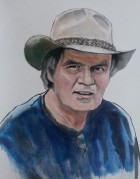
THE AUTHOR
 Byron Christopher
Awesome. Congratulations!! Great AI summary.
LikeLike
If I send you twenty will you send me a copy … and your Email for banking.
LikeLike
Wow, congratulations and I can’t wait to buy a copy!
LikeLike
Hi Byron,
Congratulations on the release of your book. I will pick up a copy and be sure to read it.
LikeLike
Awesome read!
LikeLike
Congratulations on the completion of your chapter of life. What a great, promising read the AI chapter synopsis reveals. Trusting you have successful sales as ‘Dogs in the Forest’ comes on the market.
A great Thanksgiving achievement.
Blessings.
LikeLike
I’m almost half way through reading it, it’s beautiful, beautifully done, interesting all the way, loving it.
Thank you for doing it; thank you for being you.
LikeLike