
I don’t mean to make light of dementia. Far from it. I’ve watched too many friends fall victim to this terrible disease, and there’s nothing funny about it.
But I still believe there’s room for a little humour in life, even when the subject is serious.
More on that later.
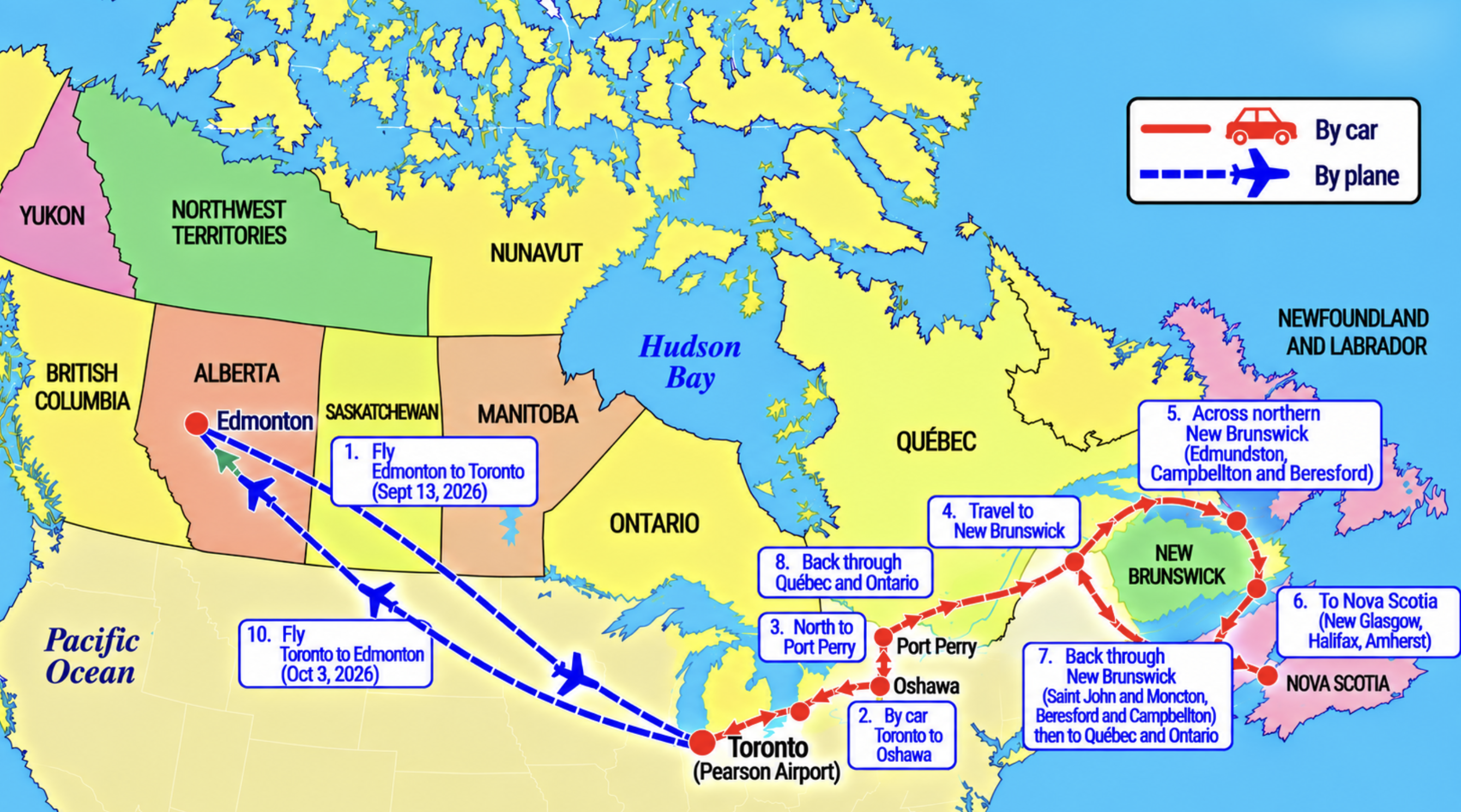
On September 13, 2026, I left Edmonton, Alberta, for a three-week trip that would take me across a good chunk of Canada.
And what an adventure it was!
Here’s a visual of my route. Click to enlarge. (Thanks to ChatGPT for helping put this map together.)
TURBULANCE BEFORE TAKE-OFF
Getting through airport security was a breeze. For once, nobody asked me to open my drone case for a thorough inspection.
Great start.
Then came the announcement. My flight, scheduled to leave around 12:20, was delayed for several hours because the aircraft was late arriving from British Columbia.
Oh well.
I don’t normally visit airport pubs before a flight, but I was thirsty, had time to kill and figured a tall glass of beer wouldn’t hurt.
Wrong.
I’d already eaten, but for some reason, the alcohol went straight to my head. Before the glass was half-empty, I was feeling a little light-headed.
I kept sipping.
By the time I’d finished, I was really buzzing.
The waitress hurried over.
“Would you like another beer?”
“No, thank you,” I replied. “I’m pretty tipsy right now, and my flight …”
I motioned toward the departure gates.
“I understand,” she said.
“No, you don’t understand.”
I leaned forward.
“I’m the pilot!”
FIFTY YEARS IN THE REARVIEW MIRROR
It was dark, but thankfully, Highway 401 wasn’t crowded as I headed east toward my motel in Oshawa, about 45 minutes away.
I’d stayed there the previous year while meeting with an entertainment lawyer about a possible movie based on my Richard Lee McNair book, The Man Who Mailed Himself Out of Jail.
But tonight, the drive east would take me somewhere else.
Back more than half a century.
MEMORY LANE WAS JUST OFF EXIT 376
Whipping along the 401 was turning into an unexpected trip down memory lane.
Then I spotted a familiar name on a highway sign.
Victoria Park Avenue. Exit 376.
Suddenly, I wasn’t thinking about the highway anymore.
I was thinking about Hardis, our two little girls and a time when we were young, had little money and were just starting out in life.
In early 1973, Hardis and I lived in our first apartment at 90 Eastdale Avenue, Unit 511. It was a tall white building with a grand, classy entrance.
I remember how proud I was to live there.
We moved in before Sonja was born.
I can’t remember what we paid in rent, but I remember something else about that apartment.
It’s where I learned to play chess.
Hardis bought me a chess set for $20. It was made of wood, with beautifully carved pieces.
Why chess?
Because, as she put it, I thought a lot.
Looking back, I realize there was something rather special about that gift. Hardis recognized something in me that made her think I’d enjoy the game.
She wasn’t just buying me a chess set. She was buying something that suited the way my mind worked.
Armed with a paperback instruction book, I taught myself to play on our dining-room table.
More than half a century later, I still have that same chess set.
It’s as good as new.
Not bad for twenty bucks.
There was a park nearby where we often took our two little girls — Sonja, born in 1973, and Heidi, who arrived a year later.
We didn’t need much of an excuse to go there. Sometimes it was simply to get outside, enjoy the fresh air and be surrounded by nature.
It was also where I practiced throwing a Frisbee with my friend James.
Looking back, those were simple times.
We didn’t own a car. Our vehicles were a baby carriage and a 10-speed bicycle.
We had two little girls, a rented apartment and a future still waiting to unfold.
We weren’t rich, but in a way, we were.
And here I was, more than 50 years later, driving past a highway exit that brought it all back.
Funny how a simple road sign can do that.
FIVE STARS NOT NECESSARY
I eventually arrived at my motel in Oshawa.
Nothing fancy, but I liked the place. For one thing, it provided a full breakfast. That’s always a selling point with me.
I’d stayed there the previous fall when I met with entertainment lawyer Warren Sheffer to discuss a possible contract with a group in Los Angeles interested in producing a made-for-TV movie about Richard Lee McNair.
We agreed to give a screenwriter the rights to shop the project around.
It had been a long day, beginning in Edmonton and ending in Oshawa.
I didn’t have much trouble falling asleep.
And I needed the rest.
The following morning, I had an appointment with a man whose story had stayed with me for years.
FIVE BULLETS AND FORTY-FIVE YEARS OF QUESTIONS
I was up early, preparing for the drive to Port Perry, about 45 minutes northeast of Toronto.
I was going to meet a man who had survived something few police officers ever experience.
Five bullets to the chest.
His name was Clarence Bourque.
In June 1981, Bourque was a young police officer in Shediac, New Brunswick, in his mid-20s.
He had his whole life ahead of him.
Then came a late-night call that would change everything.
We met in a private room at the downtown library.
I wanted to hear his story directly from him.
According to Bourque, it began with what appeared to be a routine police call.
Someone had reported a drunken man on the road.
Bourque responded.
But the man wasn’t drunk.
Instead, Bourque said, the man overpowered him, seized his Smith & Wesson revolver and shot him five times in the chest.
Five times.
The gunman then fled in Bourque’s police cruiser, switching the emergency lights on and off as he drove away.
And Bourque?
Somehow, he survived.
But the shooting was only part of his story.
There were other troubling questions, including allegations of election fraud and warnings Bourque said he’d received from civic officials.
At one point, he recalled being told that he didn’t run the town.
Then came an allegation that stopped me in my tracks.
Bourque told me that as he was leaving the hospital in a wheelchair, the mayor approached him.
According to Bourque, the mayor said:
“Want to know why you were shot? It’s because we’re family here.”
Imagine hearing those words.
You’ve nearly lost your life. You’ve been shot five times. You’re leaving the hospital in a wheelchair.
And this, according to Bourque, is what the mayor tells you.
What was he supposed to make of that?
What was anyone supposed to make of it?
There were questions about the shooting that Bourque had carried with him for decades.
And now, sitting across from me in a quiet room at the Port Perry library, he was sharing his account.
Bourque talked.
I listened.
Bourque wasn’t bitter, pointing out that those behind his shooting were likely daed by now — and he was still alive and serving the Lord.
There are interviews you conduct as a journalist that stay with you long after you’ve put away your notebook.
This was one of them.
Our meeting eventually led to a new chapter in Volume 2 of my memoirs, Dog in the Forest.
And I came away from Port Perry with a renewed appreciation for something I’ve believed throughout my reporting career:
Sometimes the most important stories are the ones that refuse to go away.
NO RESERVATION. NO VACANCY. NO PROBLEM.
I hit the road, heading toward an RCMP detachment near Montreal, hoping to meet Nelson Levesque, one of the Mounties who captured American fugitive Richard Lee McNair in Campbellton, New Brunswick, in October 2007.
I called Levesque.
He answered, explaining he was in a meeting in Montreal.
Well, so much for our get-together.
I wasn’t about to risk a complete breakdown of my nervous system by attempting to navigate Canada’s second-largest city.
No way.
Instead, I took a new highway along the southern edge of Montreal and kept driving.
By now, it was pitch-dark.
And I had a problem.
I had nowhere to sleep.
I started calling hotels and motels. More than half a dozen, in fact.
All full.
Well, not quite. A few had rooms available, but the prices were outrageous.
I wasn’t about to blow $350 just for a place to lay my head.
So I kept driving.
Eventually, I pulled off the highway somewhere west of Quebec City. For the life of me, I can’t remember the name of the place.
But I found a gas station.
That was a start.
After filling the tank, I asked the attendant if he knew of any motels nearby.
He did.
He pointed across the street.
There stood a row of four or five small motel units, all dark and apparently deserted.
Not exactly the Ritz.
But at that hour, I wasn’t looking for the Ritz.
I paid the attendant in cash.
He tossed me a key.
“Room Number Three,” he said.
That was it. No paperwork. No credit card. No fuss.
I crossed the street and let myself in.
The room was Spartan, to put it mildly.
It reminded me of my reporting days in remote communities in the Northwest Territories, where luxury accommodation meant the toilet seat was padded.
But I had a bed, a roof over my head and a door that locked.
What more did I need?
Well, there was one little problem.
A large ceiling fan was spinning directly above my head.
And I couldn’t figure out how to turn the damn thing off.
I tried.
No luck.
So I climbed into bed, closed my eyes and let the thing spin.
I slept like a baby.
GOOD MEMORIES, QUESTIONABLE JOKES
Another day. Another destination.
My tummy wasn’t full, but my gas tank was, and that’s all that mattered as I drove past Quebec City toward the New Brunswick border.
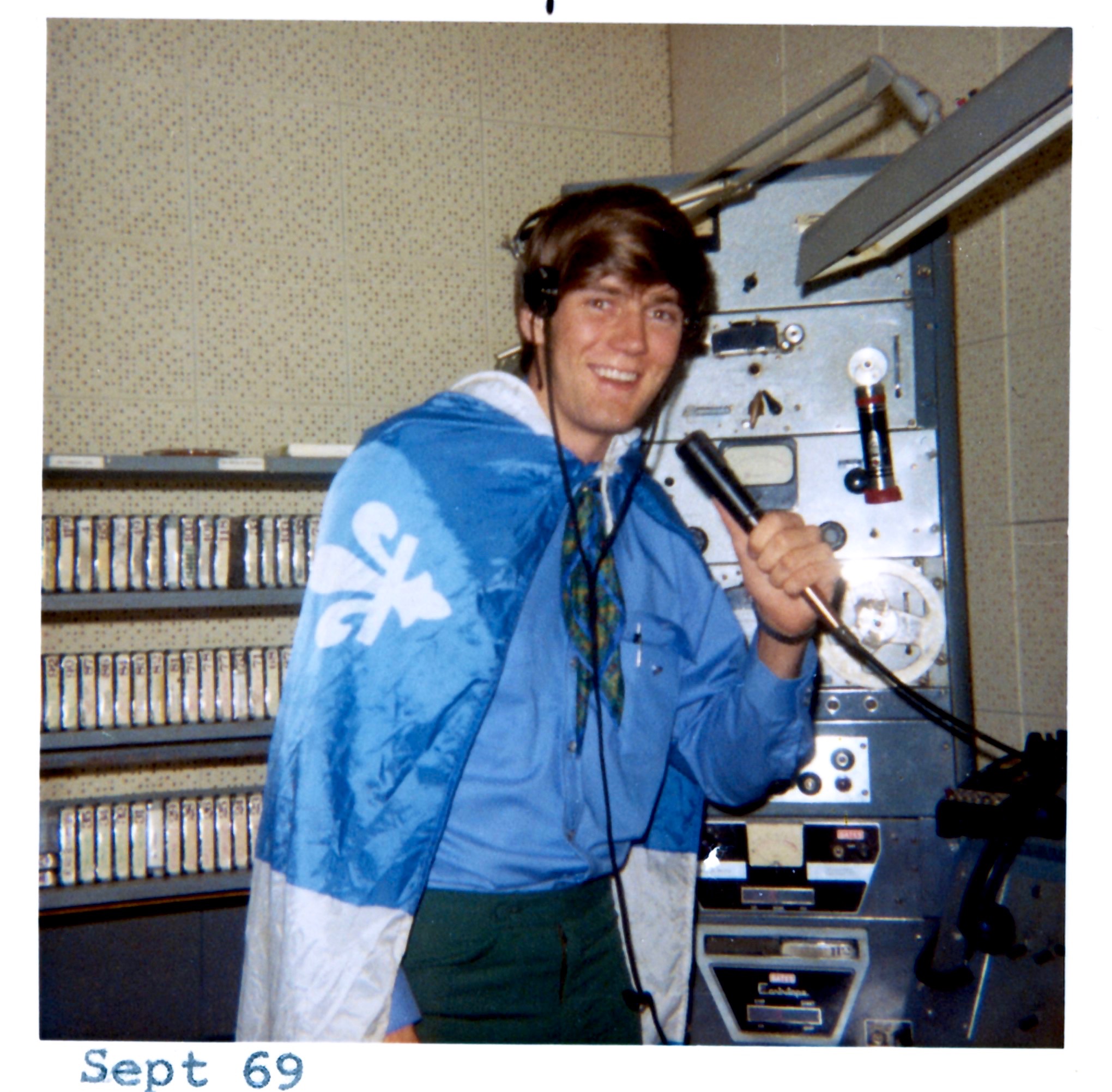
Seeing road signs for Quebec’s capital brought back memories of 1969 when I was a young DJ at CFOM Radio, the only English-language station in the area.
We’re talking the summer of ’69.
I remember getting a letter from my mother and sister. They’d been travelling by train to Montreal and managed to tune in to my morning show.
I wonder what Mom thought when she heard her son on the radio in a place far from our home in Campbellton, NB.
I can see her smiling as I write this.
Crossing into New Brunswick has always been a big deal for me. There’s something special about seeing that welcome sign, knowing I’m back in my home province.
After snapping the traditional Welcome to New Brunswick photo, I pulled into Edmundston for a bite to eat at one of my favourite restaurants — Boston Pizza.
Here’s a little trivia.
Boston Pizza was founded in Edmonton, not Boston. Former RCMP officer Jim Treliving later became involved in the business and eventually acquired it with his partner. The restaurant’s name has been linked to the Boston Bruins, Treliving’s favourite hockey team.
This was before the Oilers joined the NHL.
THE MAN WHO KEPT SMILING
I was meeting my younger brother, Al, at his hotel that evening, but I still had time for a side trip to Grand Falls, about 30 minutes away.
That’s where Dennis Arpin lived — a former coach of Canada’s Olympic cross-country ski team and, years earlier, a player with my old soccer club in Campbellton, the Speed Demons.
What a positive man Dennis had become.
Several years earlier, he’d been struck by a car while riding his bicycle. The accident nearly killed him.
I remember Dennis showing me photographs of his surgery.
My Lord.
His reaction to the ordeal?
Just part of life, he said, with a smile.
This time around, Dennis told me he’d also been treated for cancer. There had been fears he wouldn’t survive.
But he did.
And there was that same smile.
Before I headed back to Edmundston, Dennis’s wife, Bernadette, snapped a few photographs of us together.
A short but wonderful reunion, that was.
A LITTLE MALE BONDING
Back in Edmundston, I spent the evening at the hotel where Al was staying with his work crew. The men were doing sub-station maintenance at the local pulp mill.
We gathered in Al’s room, where the boys peppered me with questions about my years in journalism.
Then came the wisecracks and jokes. And some of those jokes were pretty good.
The funniest fellow in the bunch was an older man called Rudy, who, as it turned out, shared my interest in drones.
We had plenty to talk about.
Unfortunately, I can’t repeat some of the jokes here, just in case this blog is being read by an ailing nun in Ethiopia who suffers from a heart condition. I wouldn’t want to be responsible for sending her to an early grave.
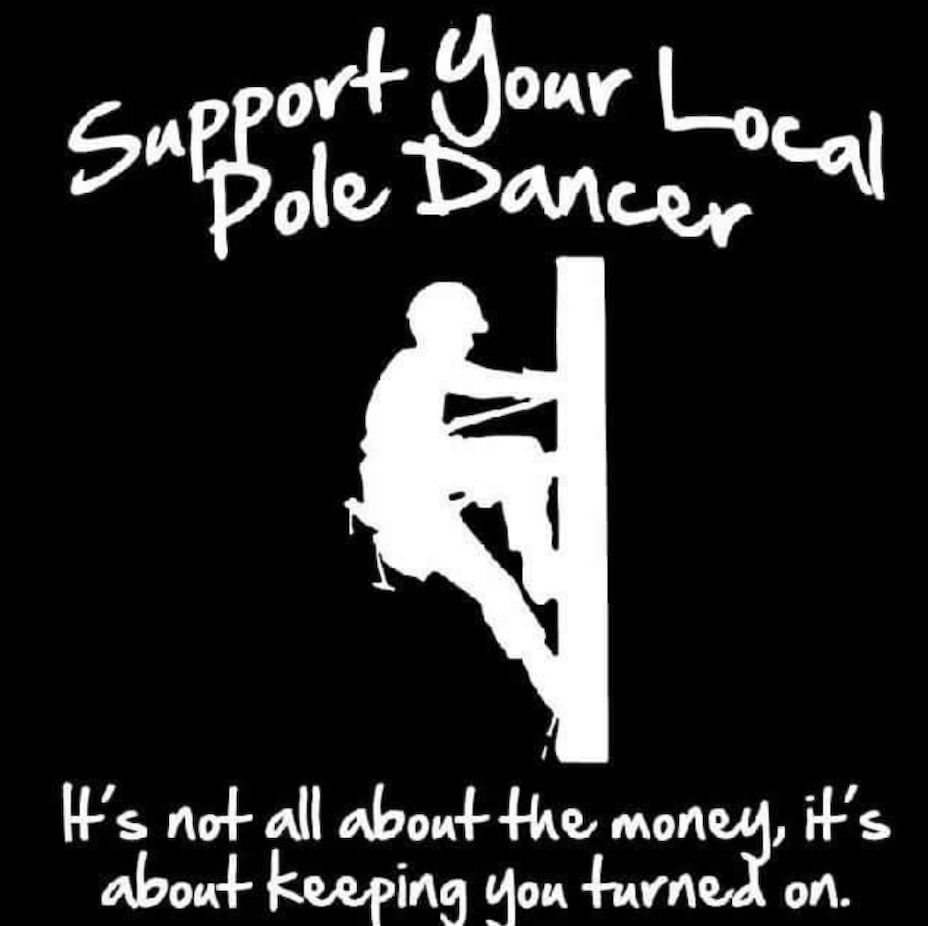
I will, however, risk inserting this cute little meme …
THE MAN WHO BUILT THE BRIDGE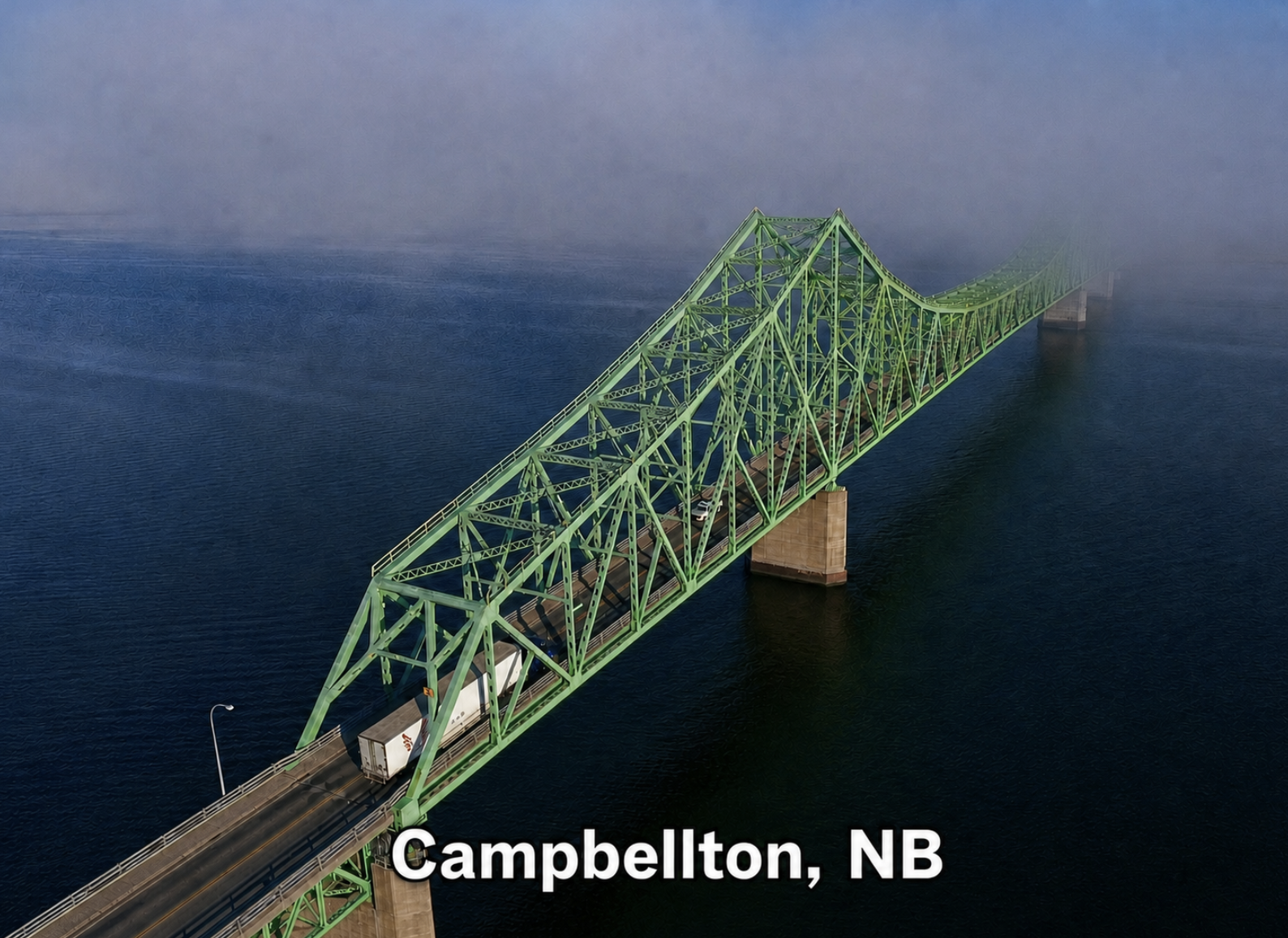 In the morning, I headed north along Route 17, the Stewart Highway, toward Campbellton. A familiar drive through the forests of northern New Brunswick.
My cell phone rang as I passed through Tide Head, a village a few miles west of Campbellton.
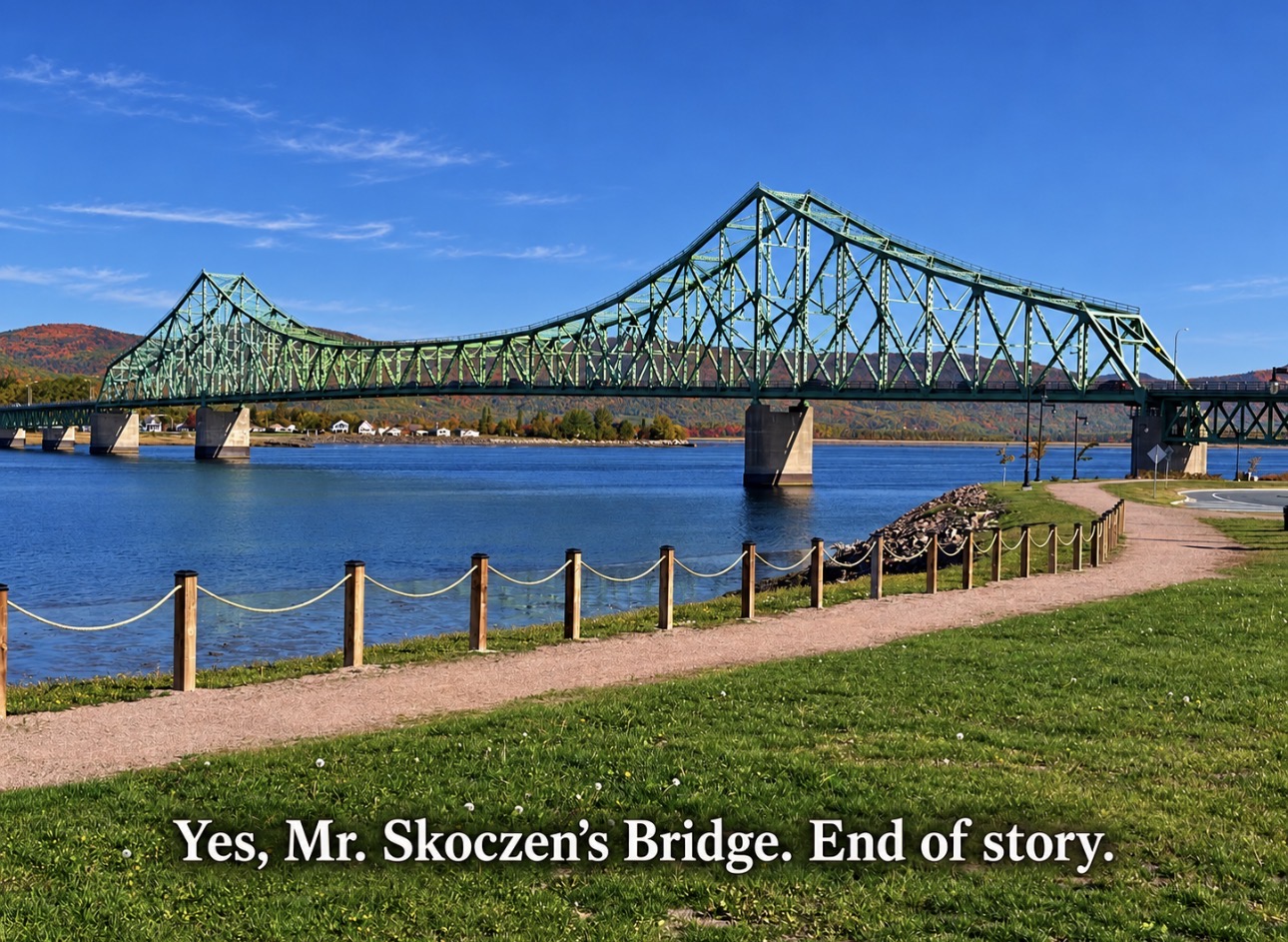
Calling from Florida was Edward “Ted” Skoczen, the chief engineer of the bridge connecting Campbellton with Quebec.
Completed in 1961, the bridge is Campbellton’s best-known landmark.
I’d tracked down Ted a few years earlier while researching a blog story about my hometown. We’ve kept in regular contact ever since.
We also have a running joke.
I introduce Ted as the man who built the bridge.
He’s quick to correct me, pointing out that he was only one of many men who worked on it.
When I pulled up outside the Restigouche Interpretive Centre, I snapped a photograph of the bridge, gave it a little AI touch-up and fired it off to Ted.