FROM SUNRISE TO SUNSET
 Life takes us from childhood to old age, with plenty of adventures along the way.
But what happens when the memories of those adventures begin to slowly disappear?
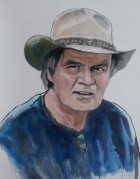
Let me tell you about Ed Poley.
Ed is a Campbellton native who left town and became a high school teacher in Saint John, New Brunswick.
We played soccer together when we were high school students. Ed was also a star basketball player with the Campbellton High team.
Decades later, our paths crossed again in Saint John.
That’s when I discovered Ed had married Debbie, a Saint John cutie who also worked in the school system. They raised a family and lived in a large house, built in the 1800s, perched on a hill overlooking the edge of town.
I was surprised — and pleased — to learn that Ed had taught journalism, emphasizing the importance of ethics.
Well.
That was music to my ears.
We soon became close friends. Ed inspired me, and I became a better reporter because of him.
The years passed.
Then dementia entered their lives.
Debbie was the first to be affected. As her condition worsened, she moved into a care facility. Ed visited her every day.
Eventually, Ed began showing symptoms of dementia himself.
Whoa!
I’d already had some firsthand experience with the disease. Another former soccer teammate, Ed Black, developed dementia and eventually died from it. I wrote about his ordeal in a blog story called Losing Your Mind.
Now another old friend was facing the same frightening prospect.
Ed Poley and I continued talking regularly on the telephone. He’d tell me how Debbie was doing, what kind of day she was having and how she was coping.
Eventually, Ed moved into the same care facility as his wife.
A SURPRISE VISIT
On the afternoon of September 25, 2026, I paid Ed a surprise visit.
I hadn’t told him I was coming.
Staff directed me to the second floor, where I found Ed in a large dining hall, holding court with several people around a table.
Perfect.
I walked up behind him, pulled out my cellphone and dialed his number.
The people at the table could see what was coming. They began smiling.
Ed answered.
“Hello, Byron. How are you?”
“Fine.”
“Ed, I’m right behind you.”
Ed turned to his left.
Nothing.
The smiles around the table grew wider.
Then Ed turned to his right.
And there I was.
I extended my hand, expecting a handshake.
Ed wanted a hug.
And a hug he got.
It was a touching moment, not only for Ed and me but for everyone at the table. They were residents, too.
Ed showed me his room, on the same floor as Debbie.
I suggested we go for a drive.
He liked that idea.
But first, he wanted to see his wife.
THE INTERNATIONAL LANGUAGE OF LOVE
Debbie was confined to a wheelchair, secured with a safety strap.
She sat quietly, her eyes barely open, her lips trembling gently.
Ed approached her, kissed her forehead and began stroking her hair.
The trembling stopped.
Then came the faintest smile.
I stood there watching.
Ed didn’t need words to communicate with his wife.
He was speaking the international language of love.
And Debbie understood.
That moment touched me deeply. It’s one of the reasons I’m sharing this story.
Dementia may steal memories, but it doesn’t necessarily erase the ability to recognize tenderness.
And what I witnessed between Ed and Debbie was tenderness at its finest.

A TRIP DOWN MEMORY LANE
Ed and I climbed into my rental, a Nissan SUV, and headed through the streets of Saint John toward his former home at 697 Bay Street.
I had the GPS operating.
Didn’t need it.
Ed was barking out directions before the lady on the GPS could get a word in.
Turn here. Keep going. Now take this street.
Nothing wrong with this guy’s memory!
We arrived in his old neighbourhood, but instead of stopping at his former house, we pulled up in front of his neighbour’s place.
Wally Nason was sitting on his porch, wearing sunglasses, puffing on a cigarette, listening to the birds and enjoying the sunshine.
Out stepped Ed.
Wally immediately got to his feet.
The two men shook hands and began exchanging stories.
I grabbed my camera and started shooting photographs.
A HOUSE FULL OF MEMORIES
Later, Ed and Wally walked over to Ed’s former home, where they met the new owners.
Ed thanked them for taking care of the old place.

Think about that.
A man dealing with dementia was thanking strangers for looking after a house he no longer owned.
That was Ed Poley.
Always thinking about someone else.
And on this particular afternoon, he was as sharp as a tack.
He knew where he was, recognized his old neighbour and seemed to remember everything about the neighbourhood.
He was full of life.
CALL IT PAYBACK
On the drive back to the care facility, Ed kept telling me what a wonderful afternoon he’d had.
He was genuinely grateful.
But as far as I was concerned, it was no big deal.
Ed had spent much of his life giving to others. He’d encouraged students, helped colleagues and inspired people wherever he worked.
Including me.
So what was an afternoon out with an old friend?
Call it payback.
When we returned to the care facility, I had one more surprise.
I showed the woman at reception a photograph of Ed enjoying his afternoon outing.
Except he wasn’t in Saint John.
He was sitting on the Great Wall of China!
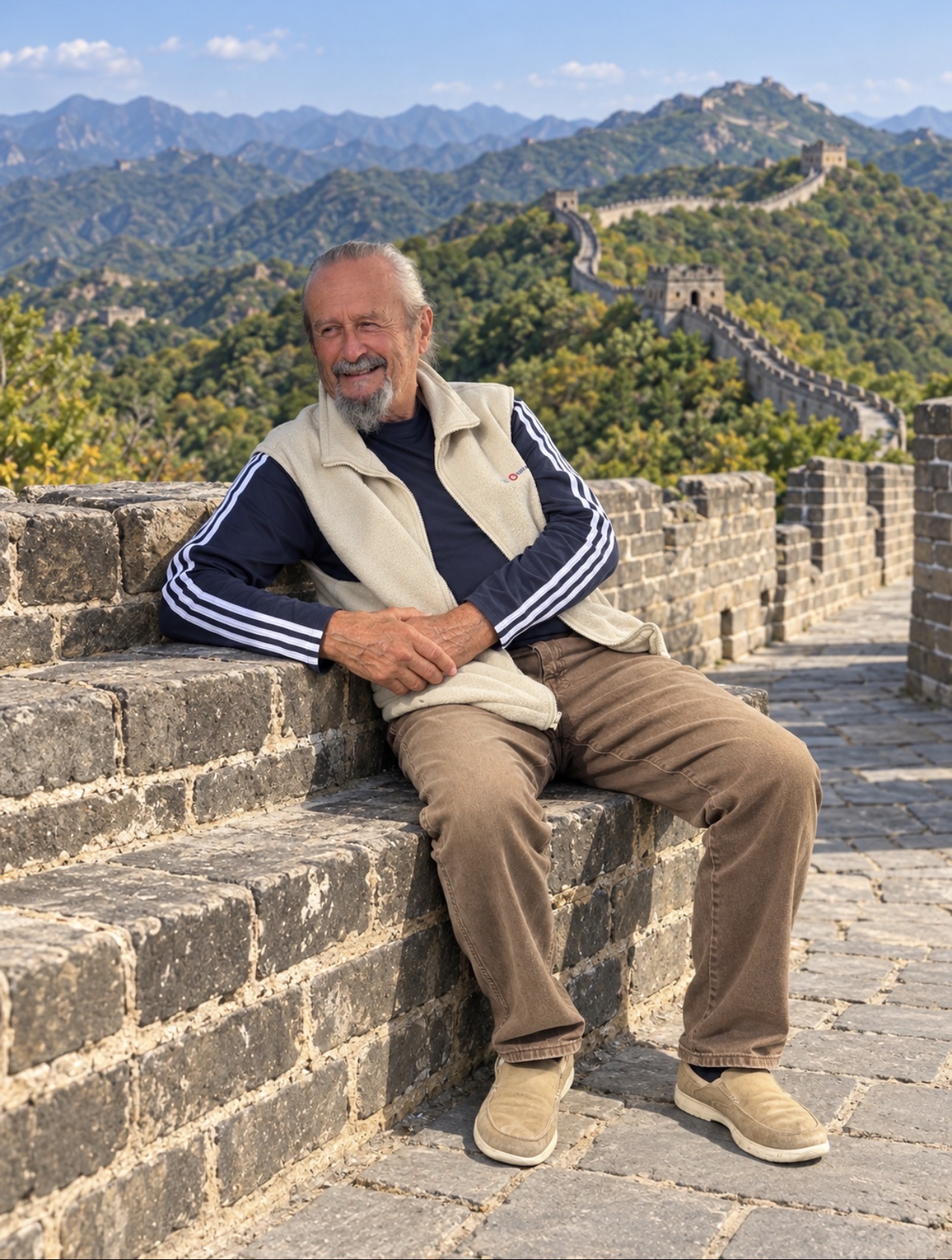
Ed Poley takes a break on the Great Wall of China. Not bad for an afternoon outing from a Saint John care facility! Thanks to ChatGPT for the chuckle.
STILL GIVING
There was something else I noticed during my visit.
Watching Ed mingle with the staff, I sometimes had trouble figuring out whether he was an employee or a resident.
He seemed to know everyone.
Always an encouraging word.
A friendly smile.
A pat on the back.
Ed was like a cheerleader, lifting the spirits of those around him.
Despite his own circumstances, he was still reaching out to help others.
But then, Ed was a former Speed Demon who played soccer under Don Hume. And knowing what Don taught us about life, that didn’t surprise me.
Dementia may change a person. But on that September afternoon, I saw something it hadn’t taken from Ed Poley.
His heart.
THREE HOUSES AWAY
After I left Ed, I headed over to the home of Sheila Robertson, née MacKenzie.
Sheila and I were the same age and had grown up just three houses apart. I hadn’t seen her since 1967 or so. Nearly 60 years. That’s a lot of catching up.
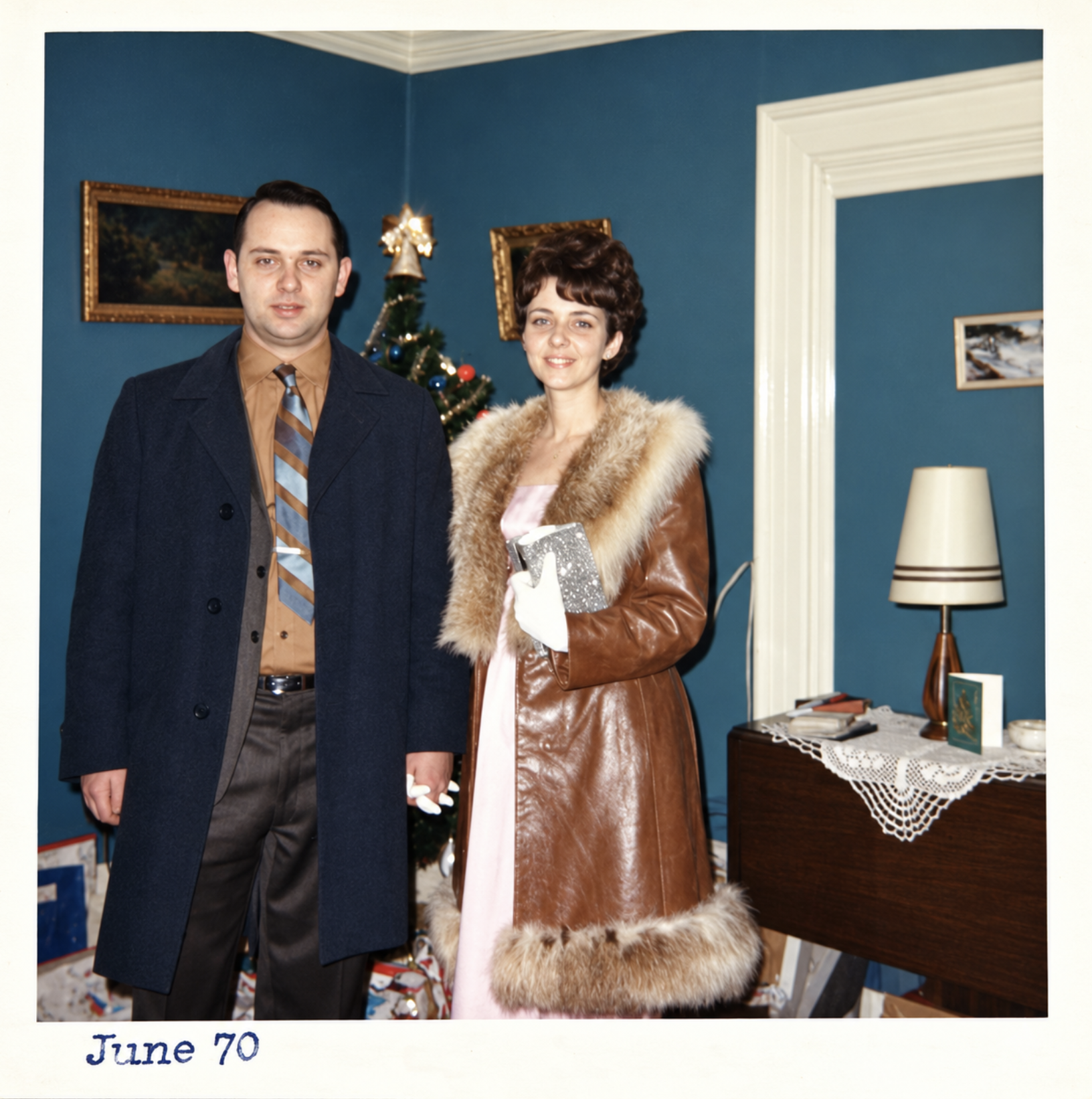
When Sheila married Jim, I was living in Australia. I’m sure my name came up at their wedding. After all, they’d met through my pen pal club, The World Wide Hockey Pen Pal Association.
Jim, who became an officer with the Saint John Police Department, died in 2018 from pneumonia. He was 74.
As far as I knew, Sheila was living alone. She was about to get a surprise visit.
Turns out, I was the one in for a surprise.
Sheila had moved to a nursing home.
I’m not making that up. A nursing home. The girl who’d lived three houses away.
Neighbours told me she was having problems with dementia.
Here we go again.
I’d just left Ed. Now this news about Sheila. Two people I remembered from so long ago, both struggling with their memories. And here I was, hoping to share a few.
I’ll try again on my next visit to Saint John. I can picture it already: I’ll walk into the dining hall, pull up a chair alongside Sheila and slip her my business card.
Then I’ll tell her about the boy who lived three houses away.
WHEN DEMENTIA WAS CALLED SOMETHING ELSE
It’s difficult to describe dementia in just a few paragraphs, but I’ll give it a try.
Dementia is nothing new. In fact, there are accounts of it dating back to Roman times.
Let’s fast-forward to the 1960s, when I first became aware of the condition. In his final years, my grandfather, on my mother’s side, was described as being in his “second childhood” and “losing his marbles.” That’s how people described the disease back then. Today, we’d recognize the symptoms as possible signs of dementia.
But here’s something else I remember. My grandfather stayed at home. He wasn’t sent off to a care facility. He was looked after by his family.
That’s how things were done in those days. Families looked after their own, even when it wasn’t easy.
Today, things are different. Many people with dementia are cared for in special facilities, although others still live at home with the help of family members.
I’m not suggesting one way is necessarily better than the other. But I do wonder how many families today could manage what families routinely took on back then.
More proof, I suppose, that times have changed.
According to the Alzheimer Society of Canada, about 800,000 Canadians suffer from the disease.
NOVA SCOTIA VISITS
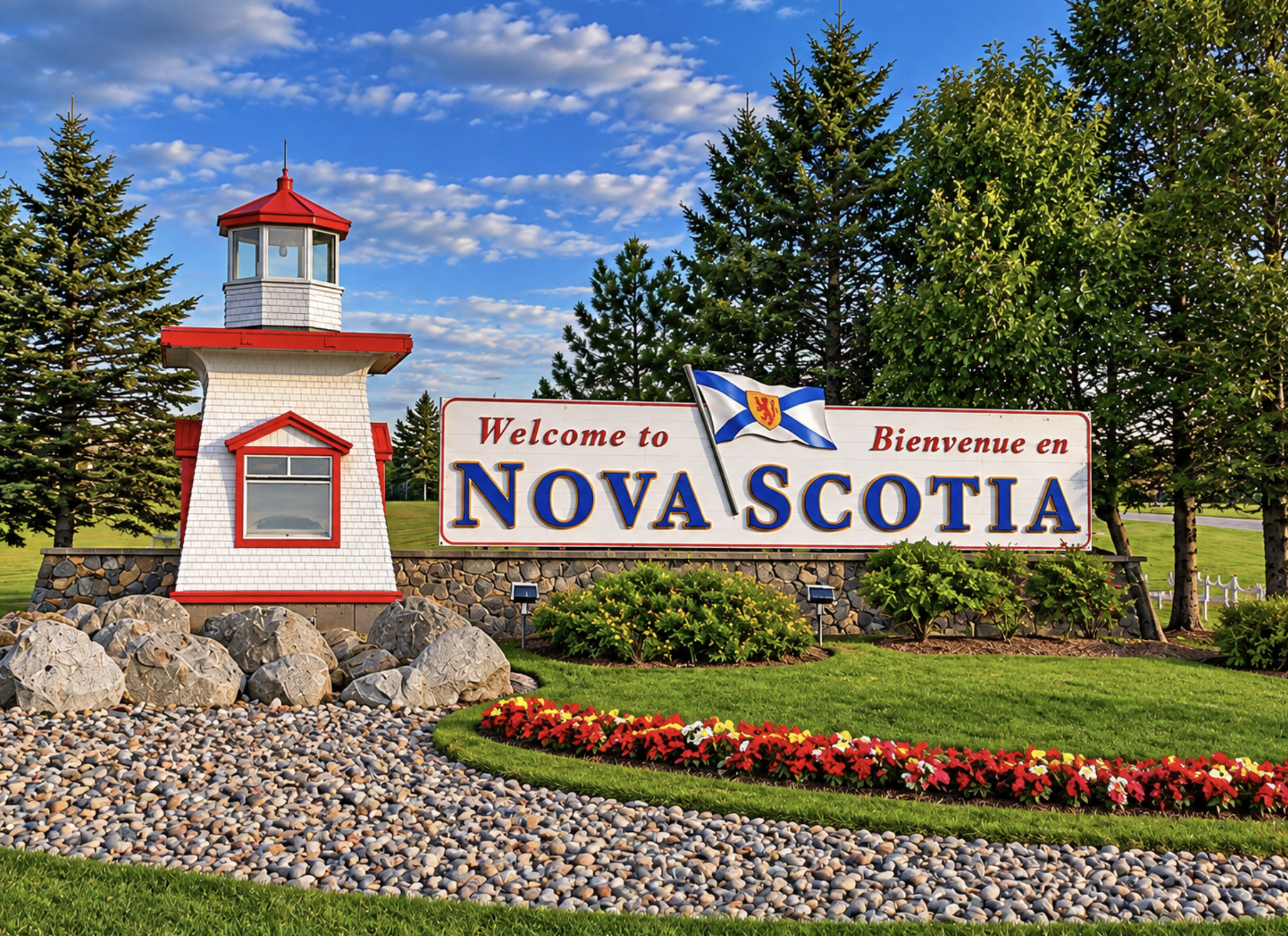
OLD FRIENDS, NEW MEMORIES
While travelling through Nova Scotia, I caught up with a number of friends — some old, some new.
And as I’ve discovered over the years, it’s often the people you meet, rather than the places you visit, who make a journey memorable.
A HOME AWAY FROM HOME
I used the home of James and Heather McMurray as my base of operations.
I’d first met the couple in Toronto in 1973. More than half a century later, we’re still close friends.
A few years ago, they moved from Brampton, Ontario, to a quiet hamlet not far from New Glasgow.
It was a wonderful place to hang my hat while exploring the province.
A highlight of my visit was playing half a dozen games of chess with James and Heather’s son, Alex. What a treat to play against a human again! LOL.
Every game ended with a smile and a handshake, just as they did when I played against Alex’s dad in Toronto many years ago.
A LITTLE HISTORY — AND A ROLLS-ROYCE
James and I stopped at the Museum of Industry in nearby Stellarton, where exhibits bring Nova Scotia’s industrial past to life — from coal mining and steelmaking to railways and manufacturing.
The museum, which opened in 1995, is well known for its historic locomotives.
It also has a wonderful gift shop with reasonably priced souvenirs.
I picked up a Nova Scotia coffee mug for a co-worker back in Alberta and two large posters of fire trucks for a retired firefighter, Gene La Rose.
Then James and I turned detective.
We tracked down the owner of a 1978 Rolls-Royce Silver Shadow.
Now we’re talking!
I own a 1973 model, but this one appeared to be in considerably better condition.
It didn’t take me long to fall in love with it.
Some men are passionate about their golf clubs.
Me?
Give me an old car with character, a little history and a beautiful set of wheels.
I’m hooked.
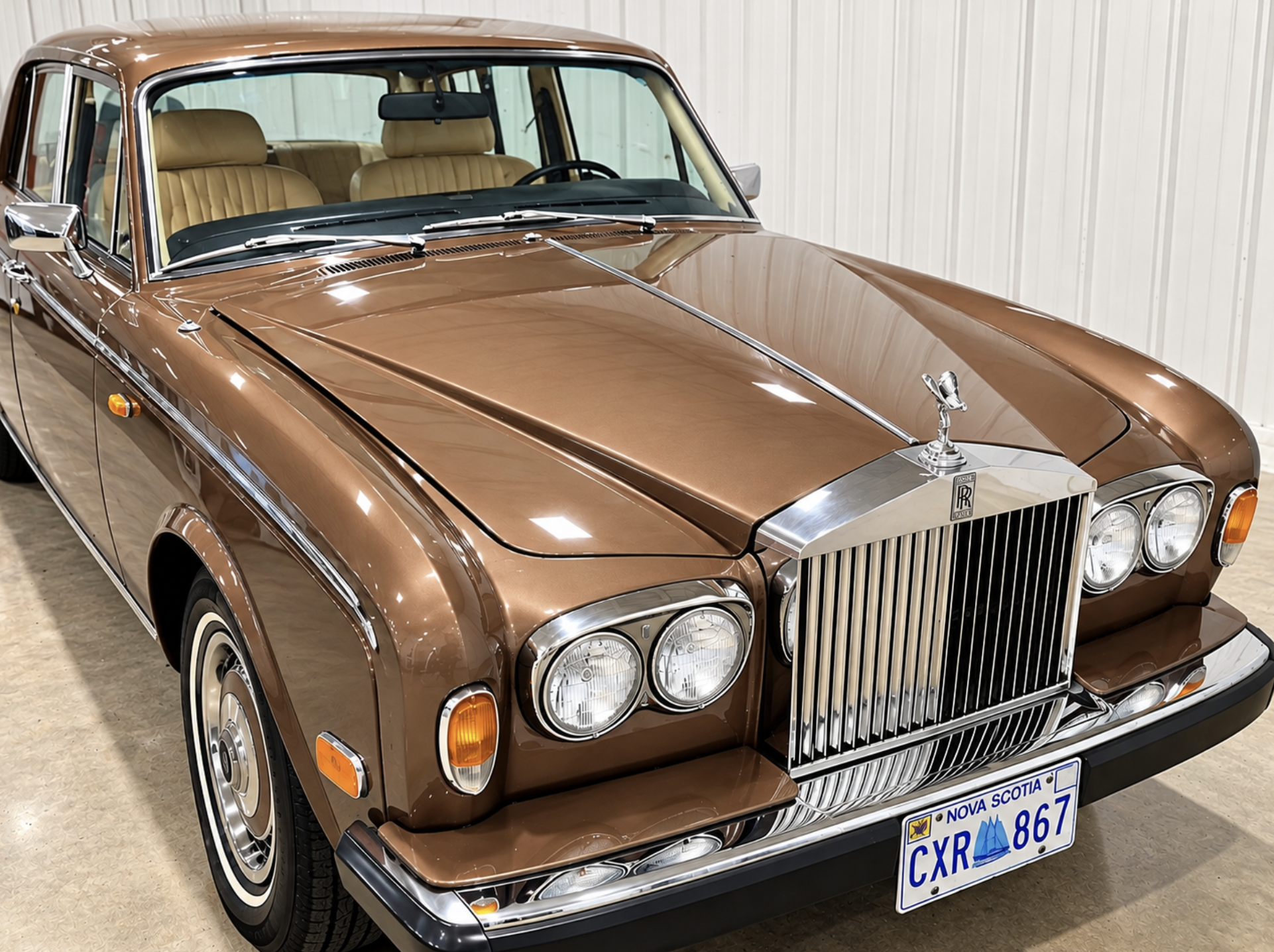
Love at first sight! A 1978 Rolls-Royce Silver Shadow in Nova Scotia. I own a 1973 model, but this beauty appeared to be in much better shape. Some men collect golf clubs. I have a weakness for antique cars.
A JUDGE WITH A SENSE OF HUMOUR
While in the area, I fired off a text to a judge I’d hoped to visit again.
Unfortunately, he was tied up with a case and couldn’t get away.
Fair enough.
I sent him another message.
I explained that the accused hadn’t committed the crime.
I had.
And if the judge played along, we could split the reward money and disappear to Ireland.
No one would ever know.
The judge didn’t sic the cops on me.
So I guess he got the joke.
TWO LITTLE COWBOYS
I also visited my niece, Trina, who married a man from Iran. They have two wonderful boys.
The youngsters took a liking to my Australian hat and wanted to try it on.
That gave me an idea.
With a little help from ChatGPT, I transported the boys to the Wild West.
Well, sort of.
I had two separate photographs, which were blended into a single image showing the boys embracing against a Western backdrop.
The result was delightful.
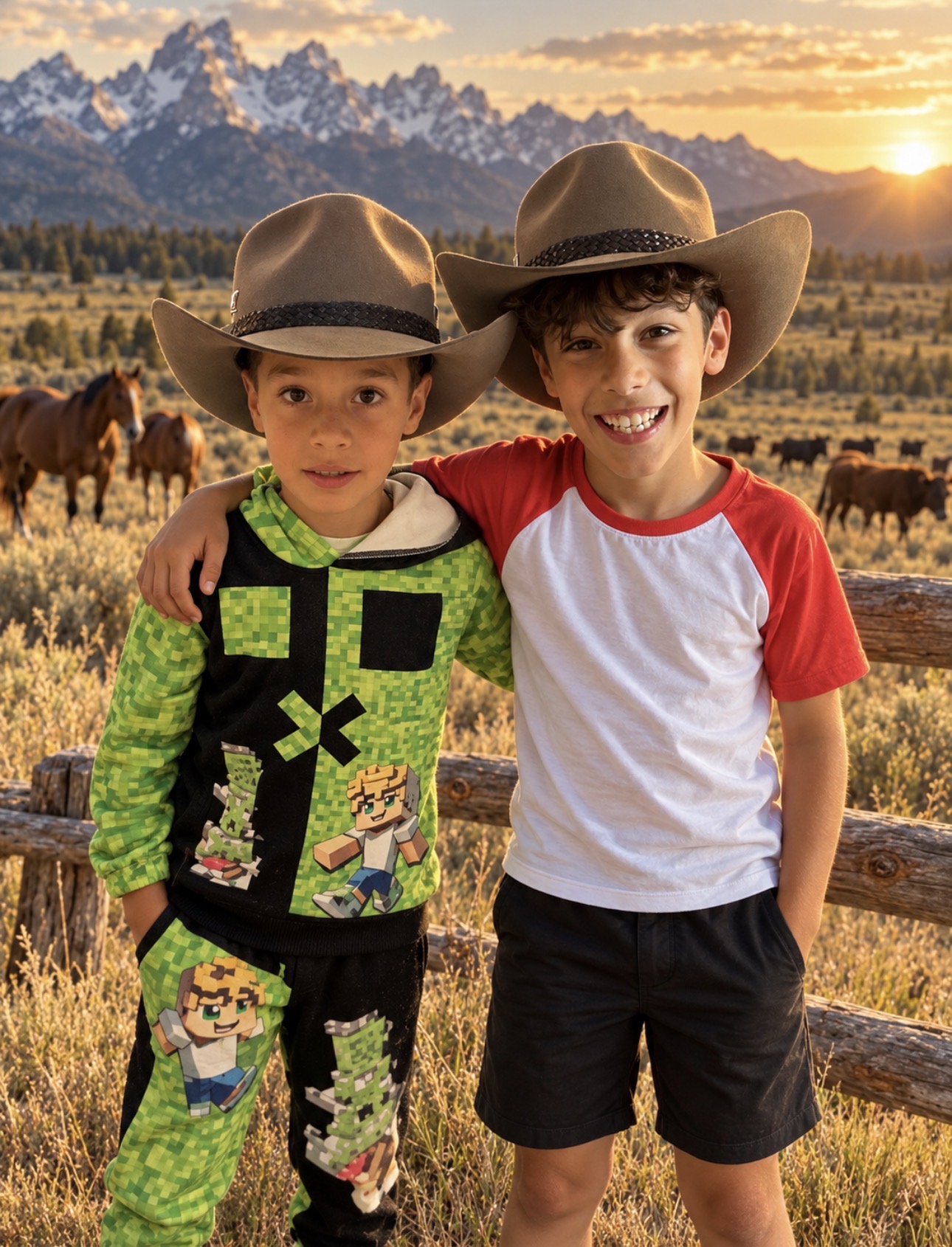
Two young cowboys, one Australian hat and a little computer magic. These were originally separate photographs, brought together with help from ChatGPT. The Wild West never looked so friendly!
Amazing what technology can do.
And here’s something to think about.
Ten years from now, this kind of computer wizardry will probably be old hat.
No one will raise an eyebrow.
Except perhaps an old reporter who still remembers typewriters, carbon paper and darkrooms.
A PHONE CALL I DIDN’T EXPECT
Not all my telephone calls led to happy reunions.
One brought heartbreaking news.
I called an old friend, Darlene Wright, who lives near Truro, and left a message.
Whenever I visited Nova Scotia, Darlene and I would get together for a meal and a good conversation.
I was looking forward to seeing her again.
But when she returned my call, she told me she was in a Halifax hospital, undergoing treatment for an aggressive cancer.
Wow.
I wasn’t expecting that.
A telephone call that should have been about arranging lunch had suddenly become something much more serious.
There wasn’t much I could say.
I wished her well and hoped for the best.
It was a sobering reminder that while we’re busy making plans, life sometimes has other ideas.
AMHERST — AND A MAN WHO KNOWS HOW TO MAKE PEOPLE LAUGH
Next stop was Amherst, Nova Scotia.
That’s where I caught up with Bryne MacIntyre and his wife, Barb.
Bryne — pronounced Brian — is a draegerman, a specially trained mine rescue worker.
We met a couple of years ago at the large cemetery in nearby Springhill, a community forever associated with devastating coal-mining disasters.
The tragedies of the 1950s claimed many lives and left scars that have endured for generations.
For a man like Bryne, whose work involves rescuing miners when things go terribly wrong, that history carries special meaning.
That evening, the three of us crossed into New Brunswick and enjoyed a wonderful meal at a family restaurant run by the Irvings.
The food was excellent.
So was the company.
Bryne is a mischievous fellow, always ready with a one-liner.
He had everyone laughing, especially Barb.
And I found myself thinking how fortunate a community is to have people like him.
People who can make others smile.
People who brighten a room simply by walking into it.
It’s a gift.
And Bryne has it.
A DIFFERENT VIEW FROM ABOVE
During my visit, I managed to get some drone photographs of Bryne and Barb’s neighbourhood.
Later, I displayed the images on their large television.
That produced a steady stream of oohs and aahs.
For about 20 minutes, we sat there looking at familiar surroundings from an entirely different perspective.
It’s amazing what you discover when you look at something you’ve known for years — but from a different angle. Remember, click on the photo to enlarge.
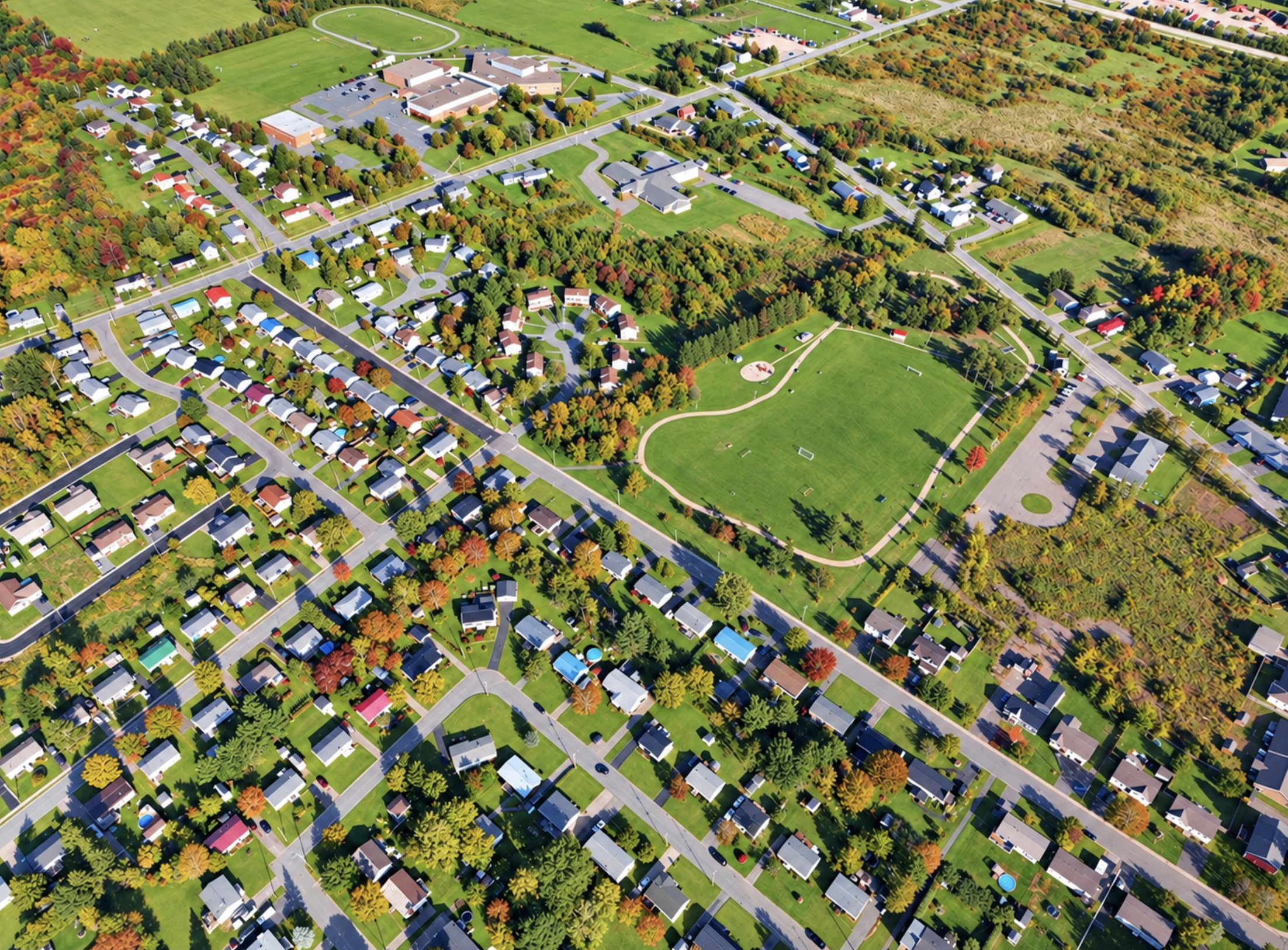
A bird’s-eye view of the MacIntyre neighbourhood near Amherst, Nova Scotia. The drone photographs provided a few surprises when we displayed them on the couple’s large television.
A FAMILIAR BOOK
That evening, before turning in, I wandered into their guest room where I’d be spending the night.
And there, on a shelf, was something that caught my eye.
A copy of my book, Dog in the Forest.
An early edition.
Unsigned.
Well, well.
Imagine travelling thousands of kilometres from Edmonton, only to discover one of your own books waiting for you in a guest room in Nova Scotia.
I smiled.
And slept like a baby.
SOME THINGS NEVER CHANGE
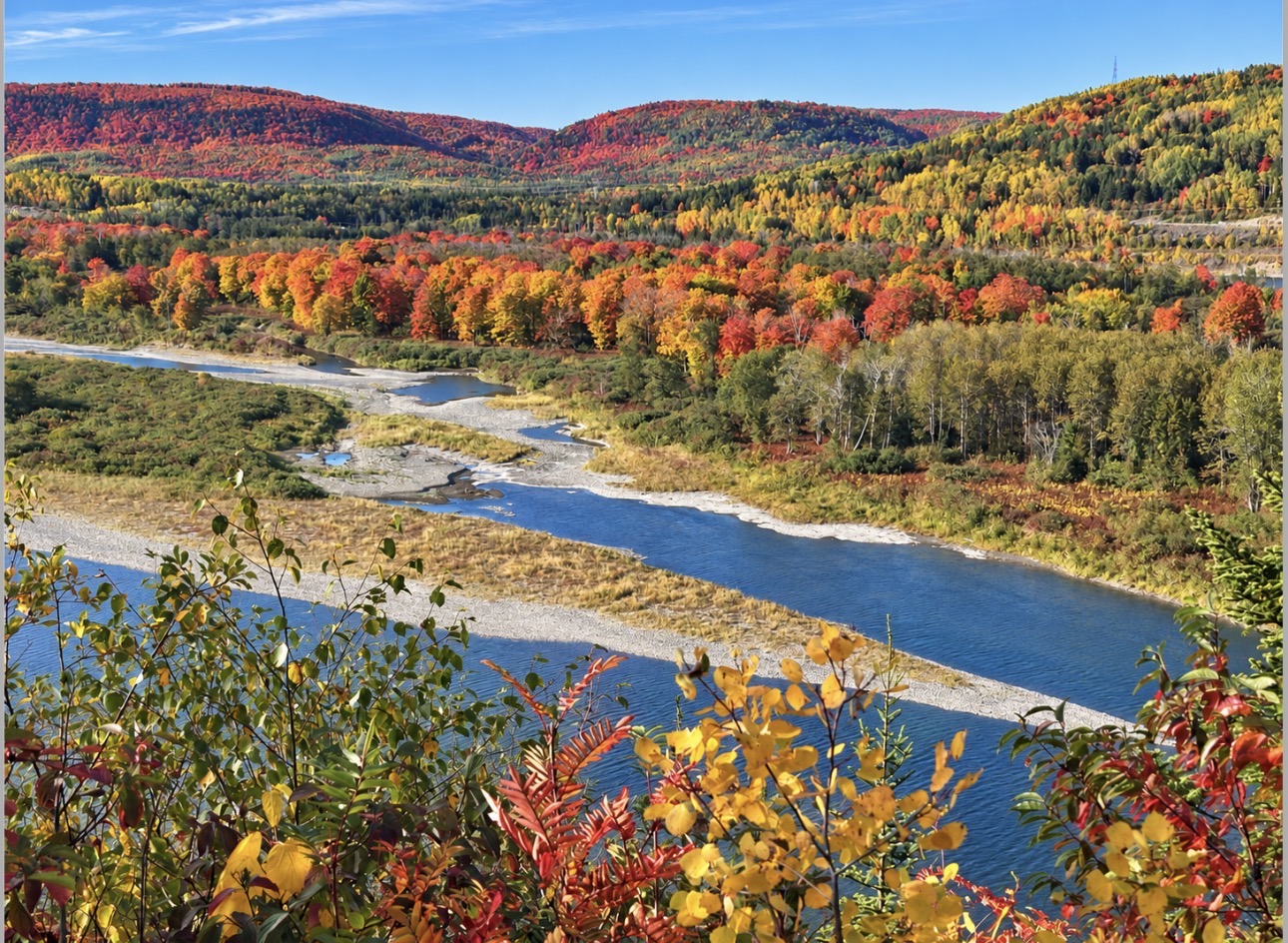
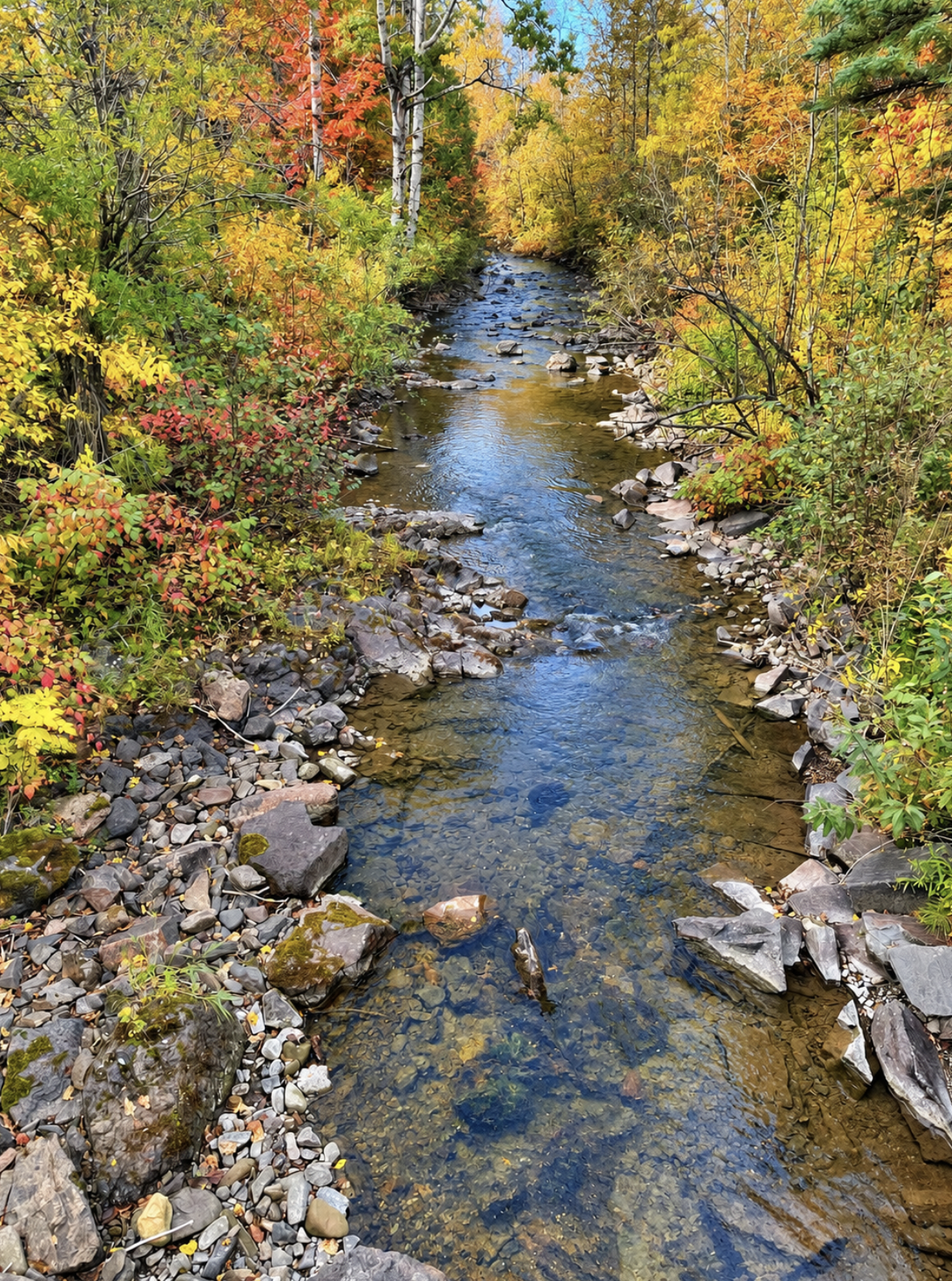
Like the spectacular fall colours in New Brunswick. Year after year, Mother Nature puts on a show, and she never disappoints.
The first photo was taken from the lookout at Morrisey Rock in Tide Head, just west of Campbellton. What a view!
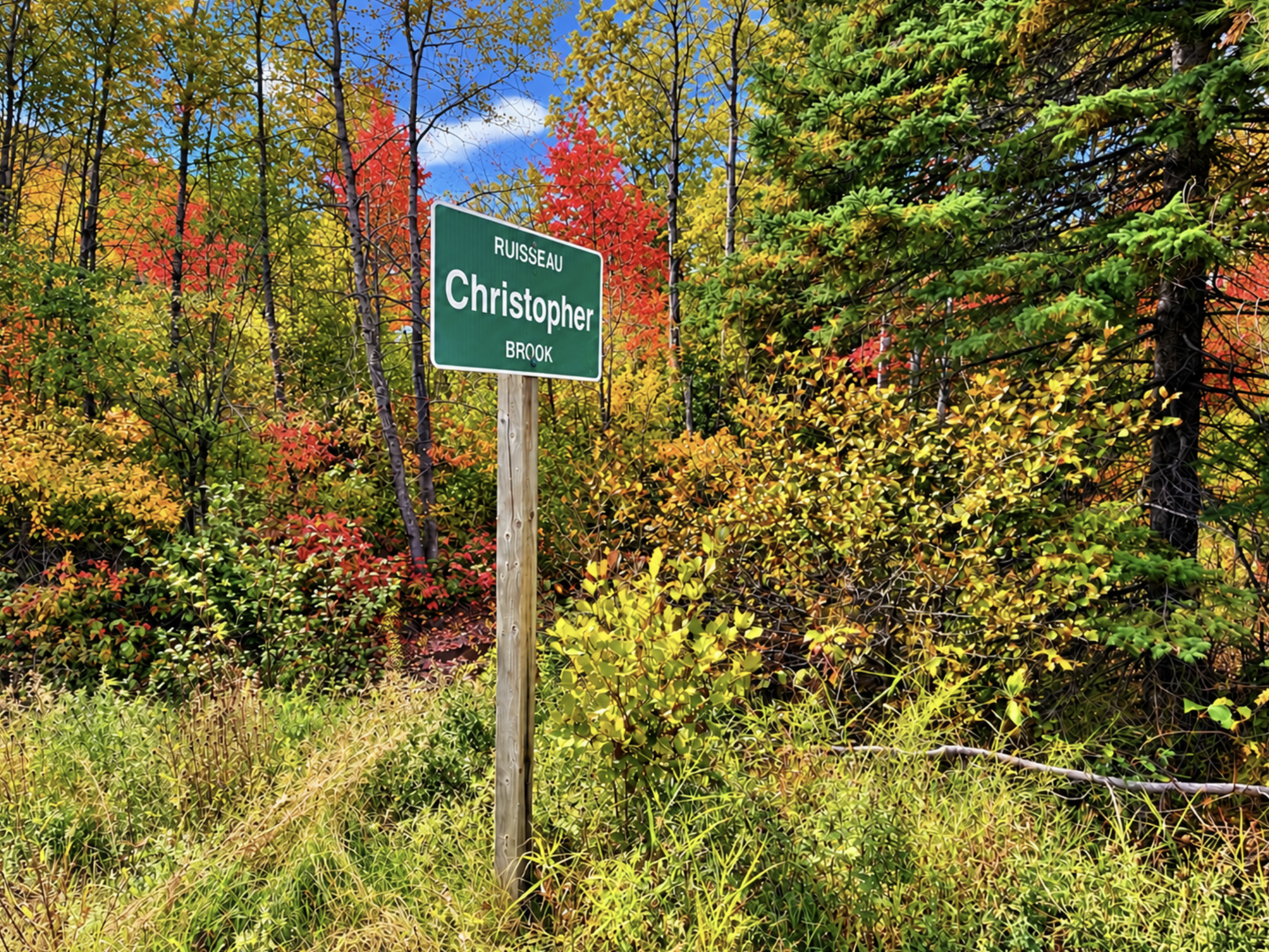
The second? Well, what do you know? It’s Christopher Brook, along the road to Val-d’Amour and St. Arthur.
And yes, there’s a family connection. Christopher Brook was named after my family — my grandfather on my father’s side, to be specific.
Some things never change. And thank goodness for that.
SOME THINGS DO CHANGE
I went around to see Alain LaForest, who, combined with his father, Camille, ran one of Campbellton’s most popular stores.
Their business philosophy was simple: Look after the customer.
And they sure did.
People came from miles around — not just for the products, but for the service. You weren’t simply another customer. You were somebody. They knew your name, asked about your family and gave you the time of day.
The unique father-and-son duo was featured in Saltscape magazine a few years back.
I know. I wrote the story.
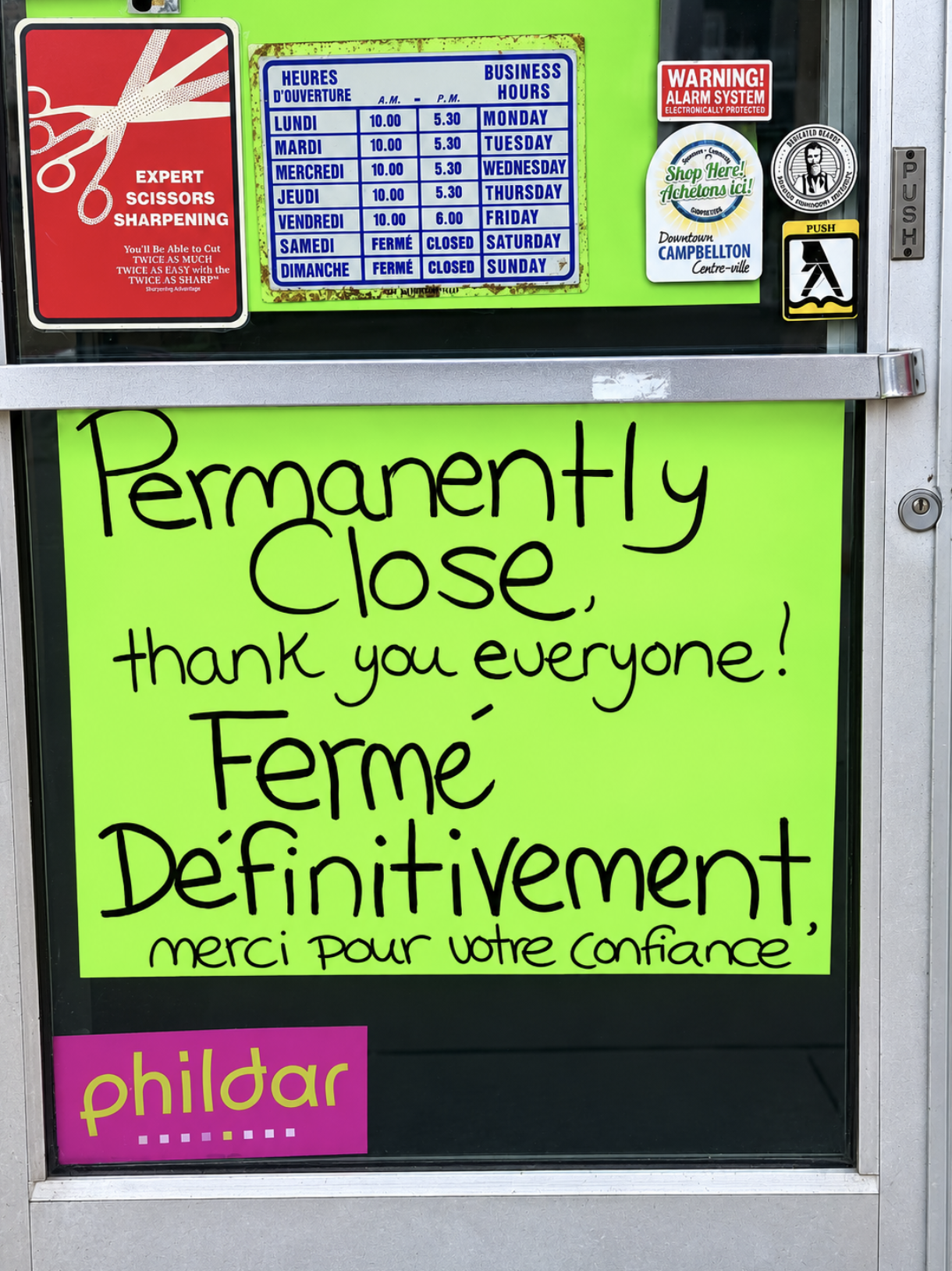
I shaded my eyes from the sun and peered through the window.
Not a soul.
There was a time when the place would have been bustling with customers. Someone would be behind the cash register, chatting with a familiar face, asking about the family or catching up on the latest news.
Not anymore.
Camille died earlier this year. He was 91. And now his son, Alain, is battling cancer.
I stood there for a moment, remembering what this place once was.
Then something caught my eye.
Hanging on the wall behind the cash register was a framed copy of my Saltscape magazine story. Still there. Proudly displayed.
The frame was a gift from John Van Horne, whose father, Charlie, a prominent politician in his day, had the bridge named after him.
John has since moved to Fredericton. His famous dad is long gone. Camille is gone, too. Alain is fighting for his health.
And those rock-solid family businesses that seemed destined to last forever? They’re changing hands, disappearing or becoming memories.
I suppose that’s what happens when the years roll by.
People move away. Familiar faces disappear. The places we remember aren’t always the places we find when we return.
Some things never change.
But some things do.
And sometimes, that’s a hard thing to accept.
EVERY DAY IS REMEMBRANCE DAY
Well, it is for me.
Hardly a day goes by when I don’t think about my father, particularly his final days. There are things I wish we’d talked about, questions I wish I’d asked and stories I wish he’d told me.
But I suspect there’s hardly a person on Earth who hasn’t felt that way about someone they’ve lost.
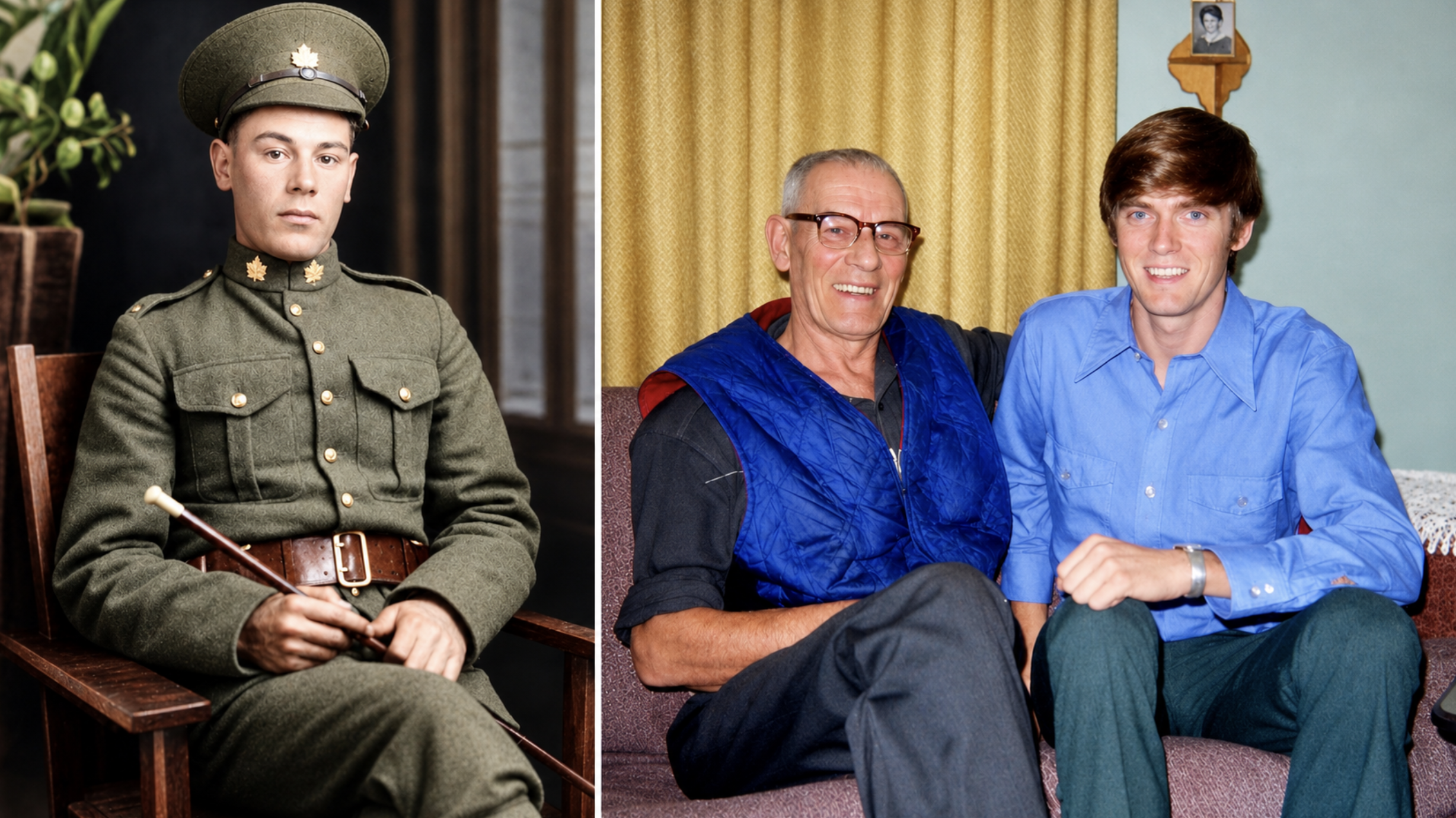
A few paragraphs below is a photograph of my father when he was about 17. He’d enlisted in the army after lying about his age, as so many young fellows did back then.
The picture was taken in London, where he was waiting to be shipped to the front lines. Quite possibly to die, you know, for “King and Country.”
Fortunately, that never happened. The war ended before he was sent into battle.
In the second photograph, I’m sitting beside Dad. I was 20 years old and about to leave home for a radio/TV job in British Columbia.
Here’s something interesting. There’s only about three years’ difference between our ages in those two photographs.
Two young men, separated by a generation, each about to embark on a very different adventure.
One preparing to go to war. The other preparing to go on radio and TV.
And speaking of remembering, take a look at the war memorial in Campbellton.
It honours men from the Campbellton area who lost their lives in the two World Wars and the Korean conflict.
More than 100 names are engraved on that monument.
Think about that.
More than 100 men from a relatively small community. Young men who left behind parents, wives, sweethearts, brothers and sisters.
Men who never came home.
Each name represents a life cut short, a family forever changed and a future that never happened.
It’s a staggering loss for a community the size of Campbellton.
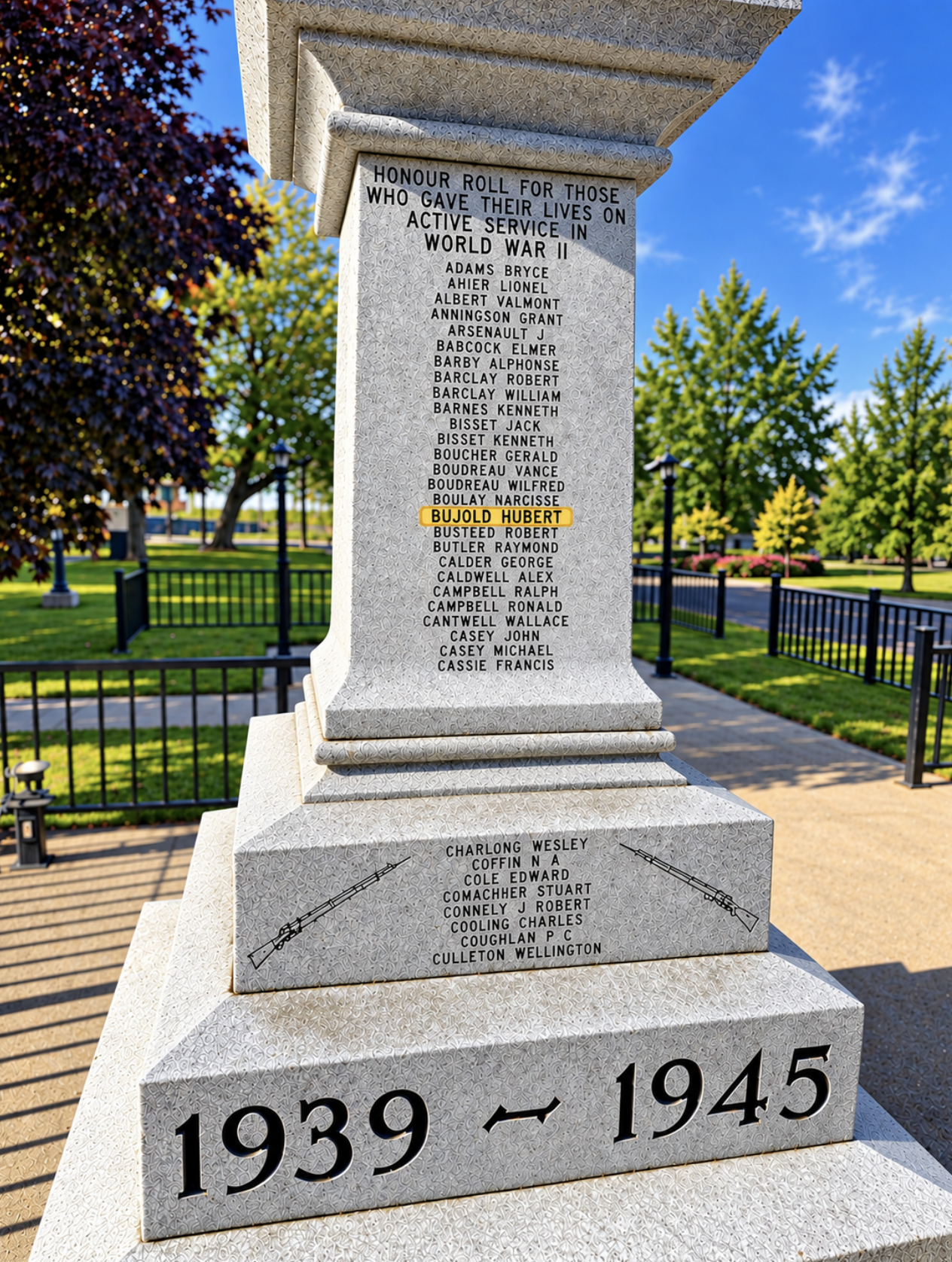
The highlighted name is that of my uncle [Hubert Bujold] who was killed by a mortar shell while defending Hong Kong from a Japanese attack in WW2.
We set aside November 11 to remember those who served and sacrificed.
And rightly so.
But remembering doesn’t have to be confined to one day on the calendar.
For some of us, every day is Remembrance Day.
THE TEACHER I NEVER FORGOT
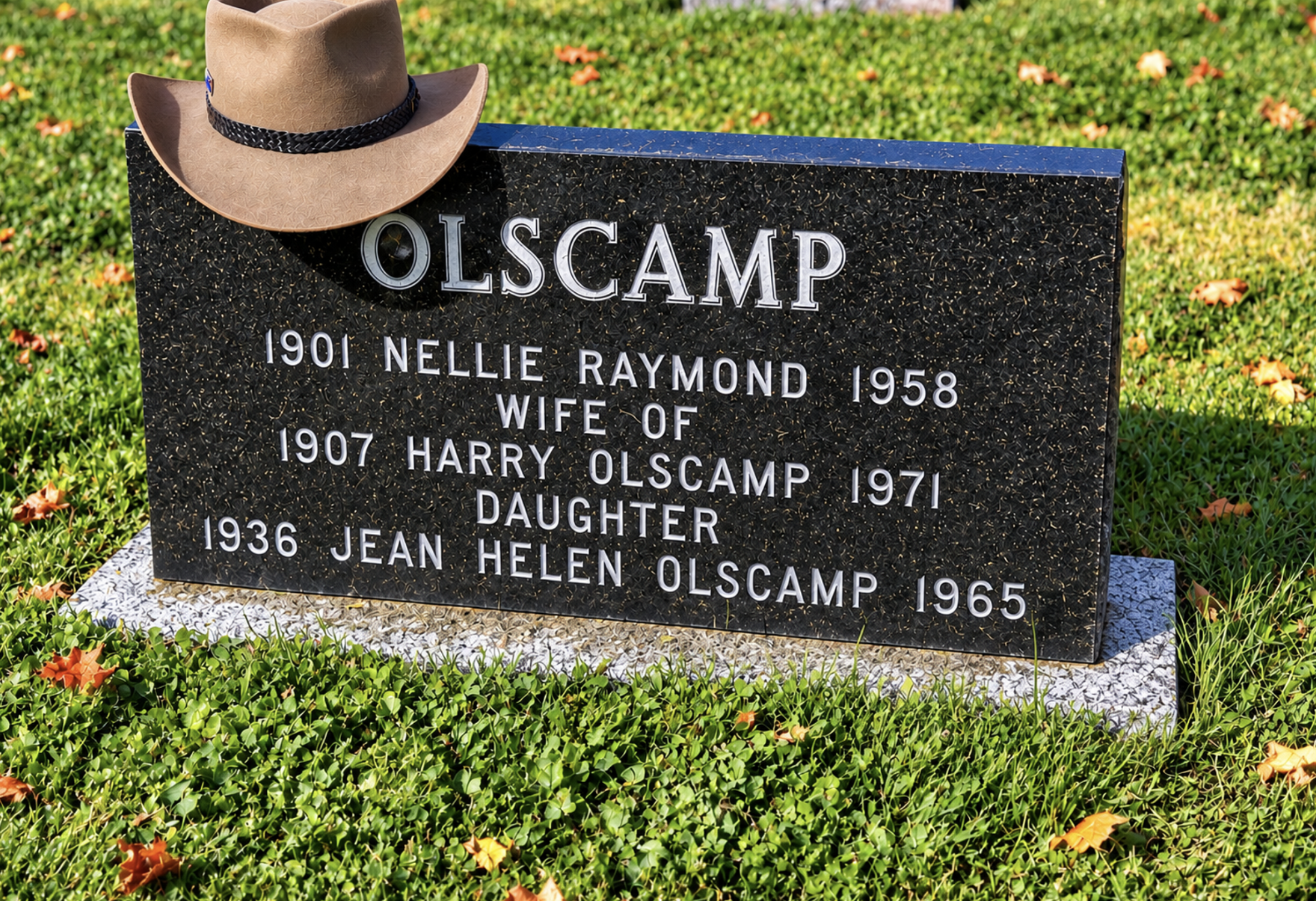
There’s hardly a visit “back home” when I don’t stop by the grave of Jean Olscamp in Tide Head.
Jean was my Grade 10 teacher when she was killed in a car crash in 1965. She and another teacher were returning from a teachers’ meeting in Fredericton when their car went out of control near Beresford, not far from Bathurst, and slammed into a bridge abutment.
Jean was thrown through the windshield and died instantly.
She was one of the most popular teachers in our high school. Full of spark, warmth and compassion. She had that special ability to connect with young people, to make them feel they mattered.
And she certainly mattered to me.
I was just a teenager when we lost her. At that age, you don’t expect someone so full of life to be gone so suddenly. It’s difficult to understand, let alone accept.
But I’ve never forgotten her.
More than 60 years have passed, and whenever I’m back in Campbellton, I make that little trip to Tide Head.
I stand by her grave for a few moments, remembering a wonderful teacher whose life ended far too soon.
More than half a century later, I still miss her.
MORE THAN JUST A VOICE ON THE RADIO
Meet Steve, morning show host at CKNB, now known as 100FM.
For several years, Steve has interviewed me whenever I’ve returned to Campbellton. Before him, it was Mark Firth who did the honours.
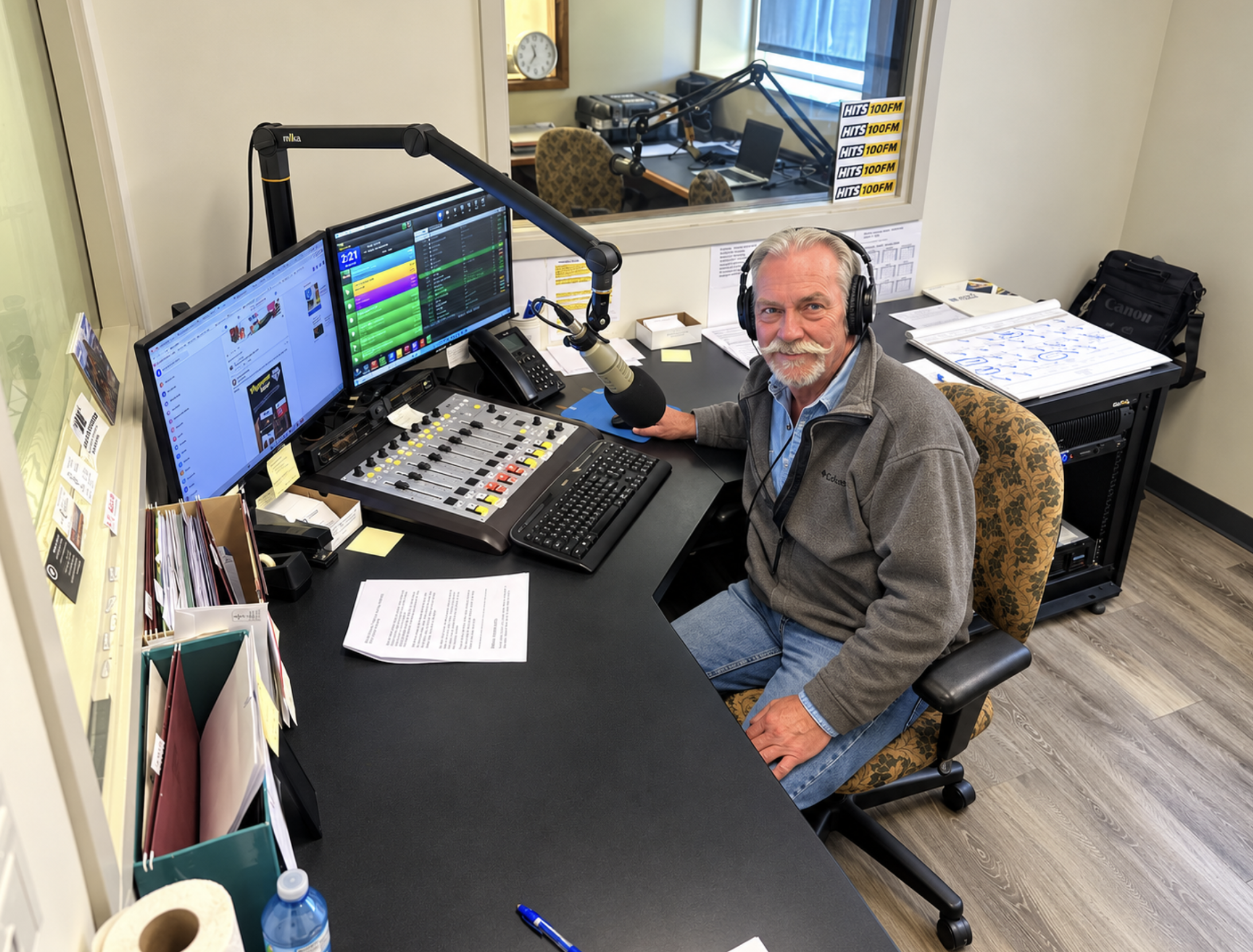
On this visit, I popped around to the station to say hello — and goodbye. I was leaving town the following day.
This time, however, the tables were turned. Instead of Steve asking me questions, I started asking him about his career and how he’d ended up behind the microphone in Campbellton.
My Lord. What a story!
Turns out Steve has called play-by-play hockey for a team in the American Hockey League, worked in several provinces and played hockey himself.
He’s certainly covered a lot of ground — both on and off the ice.
And here I thought I was just dropping by to say goodbye!
What an interesting life this fellow has led. It got me wondering how many of his listeners know about his background.
There’s often a lot more to the person behind the mic than the voice coming through the radio.
And Steve is a good example.
ONE LAST LOOK AT NEW BRUNSWICK
I decided to hit the road early for Ontario. Like 4 AM early.
I pulled out of my brother’s place in Beresford, zipped past Campbellton, still wrapped in darkness, and was soon heading toward the Quebec border.
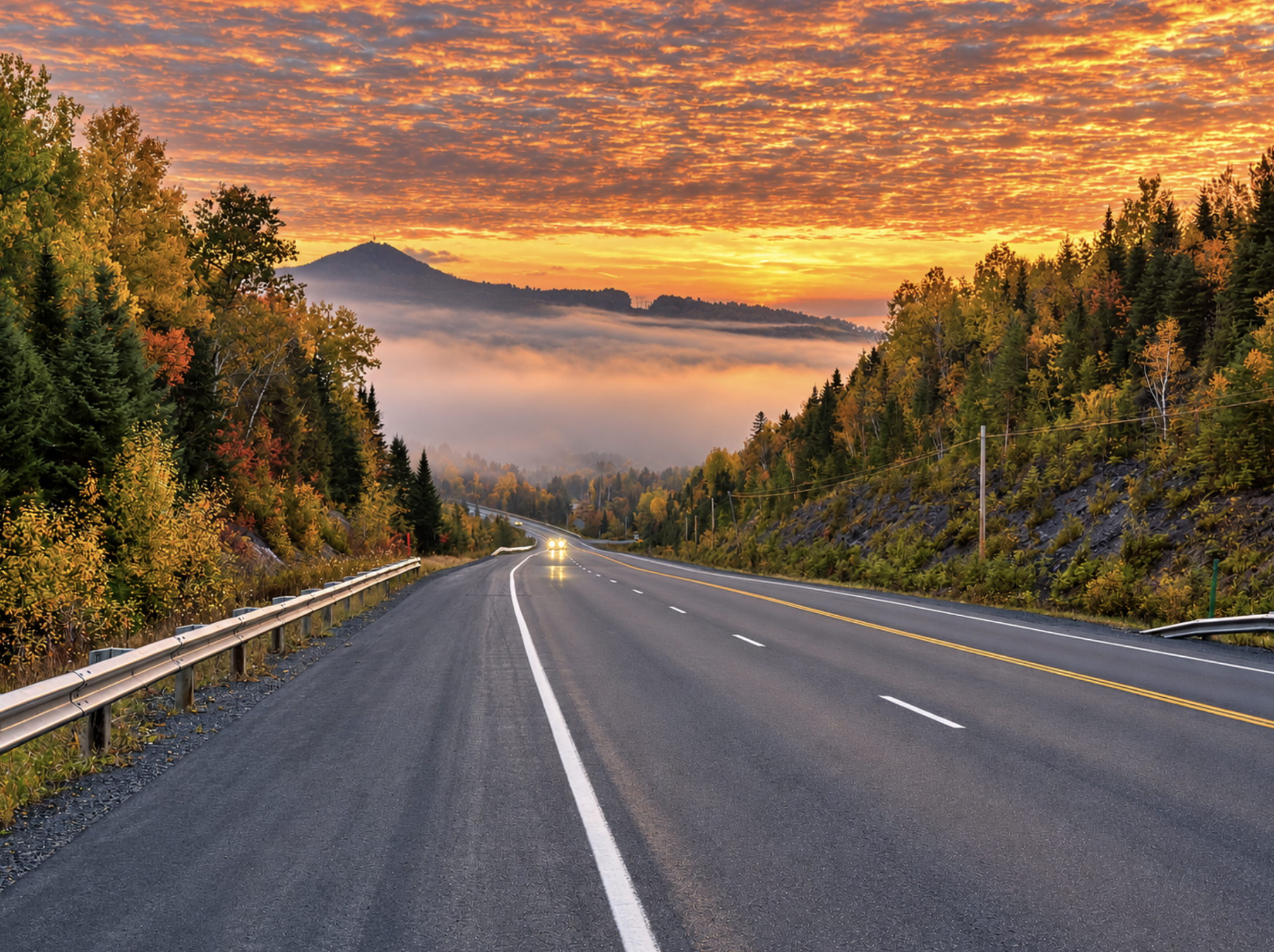
The sun was beginning to rise, and somewhere before Kedgwick, I pulled over.
What a sight.
The morning mist hung over the valley, and the sky was ablaze with colour. It was one of those moments when you just have to stop, take it all in and appreciate what Mother Nature has put before you.
I reached for my camera.
One final shot before leaving New Brunswick. A beautiful farewell from a province that, no matter where life takes me, will always be home.
And yup, click on the photo to expand it. It’s worth a closer look.
OLD CARS, NEW FRIENDS
A friend once asked me what I’d do if I won a million dollars.
Easy.
I’d buy a collection of antique cars and cases and cases of grapefruit/vodka coolers.
The rest of the money I’d probably waste.
LOL.
I’ve always had a soft spot for old cars. Whenever I travel, I’m on the lookout for them. They don’t have to be in showroom condition. Heck, they don’t even have to be running. But if they are, so much the better.
There’s something about those old machines — the styling, the chrome, the character. They were built in an era when you could identify a car from a block away.
Here are a few beauties I spotted on my latest trip Back East.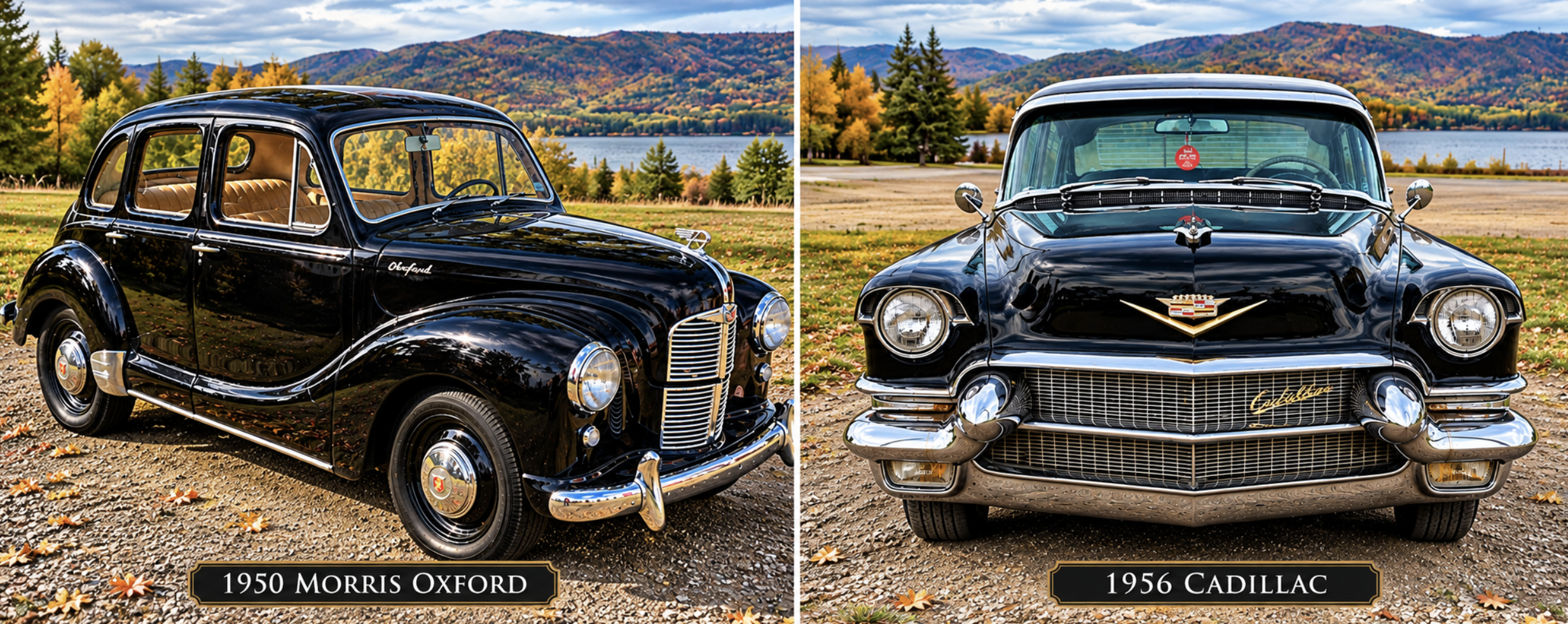
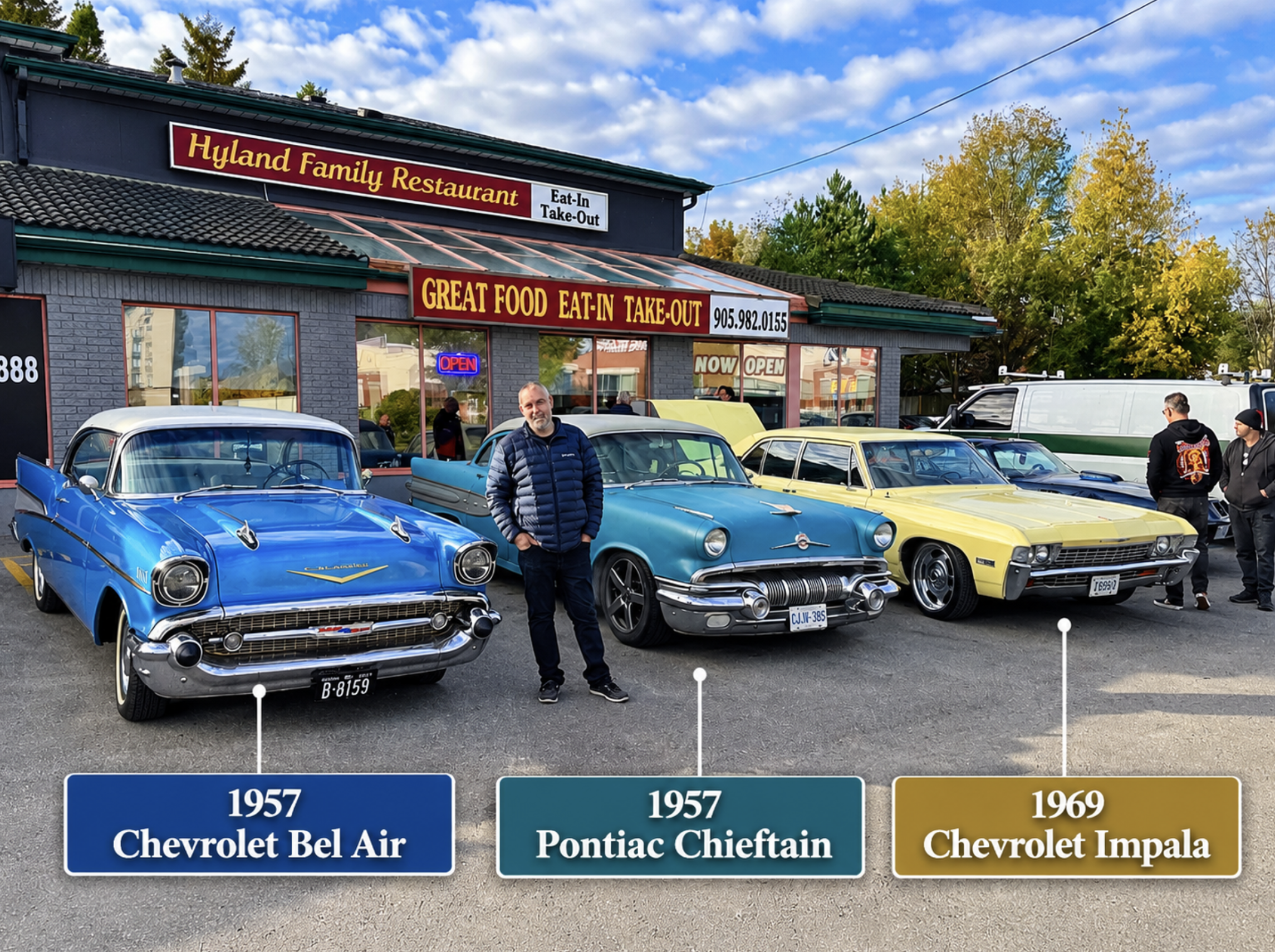 And now, a little story behind the photo above.
I was in Port Perry, Ontario, looking for a place to have breakfast when I spotted half a dozen vintage cars parked outside a mom-and-pop restaurant.
Well, that got my attention.
Inside, I noticed a group of fellows sitting together, some distance from my table. They were the owners of those beautiful old cars.
Before ordering breakfast, I called the waitress over and told her I wanted to put $100 toward their food bill.
She looked at me, and I explained what I had in mind.
No special occasion. No strings attached. Just a little surprise for a group of complete strangers.
She agreed.
When the fellows placed their orders and learned that a good part of their bill had already been paid, I suddenly heard some loud voices.
Uh-oh. What have I started?
Next thing I knew, the whole gang was heading toward my table.
Handshakes all around.
Turns out they were on their way to a car show, and we’d just happened to cross paths.
We chatted for a while, mostly about their cars, and eventually went our separate ways.
Or so I thought.
As I was preparing to leave, the fellows came over again.
More handshakes.
And this time, an embrace.
Imagine that. A bunch of strangers brought together by a few old cars and a hundred-dollar bill.
I’d always wanted to do something like this — surprise complete strangers with an unexpected gift, simply to brighten their day.
And you know something?
I think I got as much pleasure out of that hundred dollars as they did. Maybe more.
Old cars.
New friends.
Not a bad return on a hundred bucks.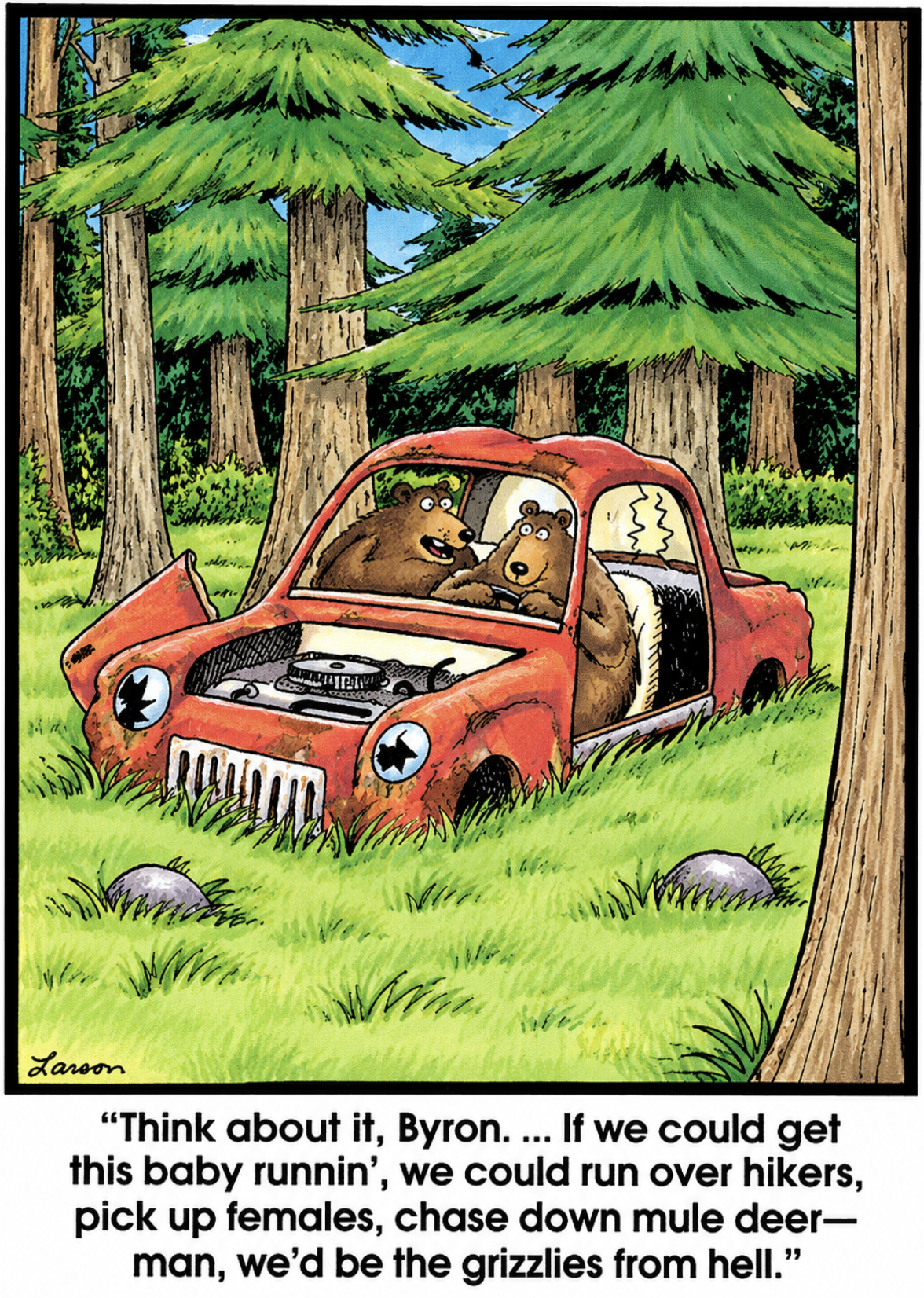
SMALL DOGS, BIG PERSONALITIES
I’m also on the lookout for Yorkshire Terriers.
I have one myself — an American Yorkie named Benji. A real cutie, although he has one annoying habit. He insists on barking at dogs three or four times his size.
Apparently, nobody has told Benji he’s a little dog.
But I love the little rascal just the same.
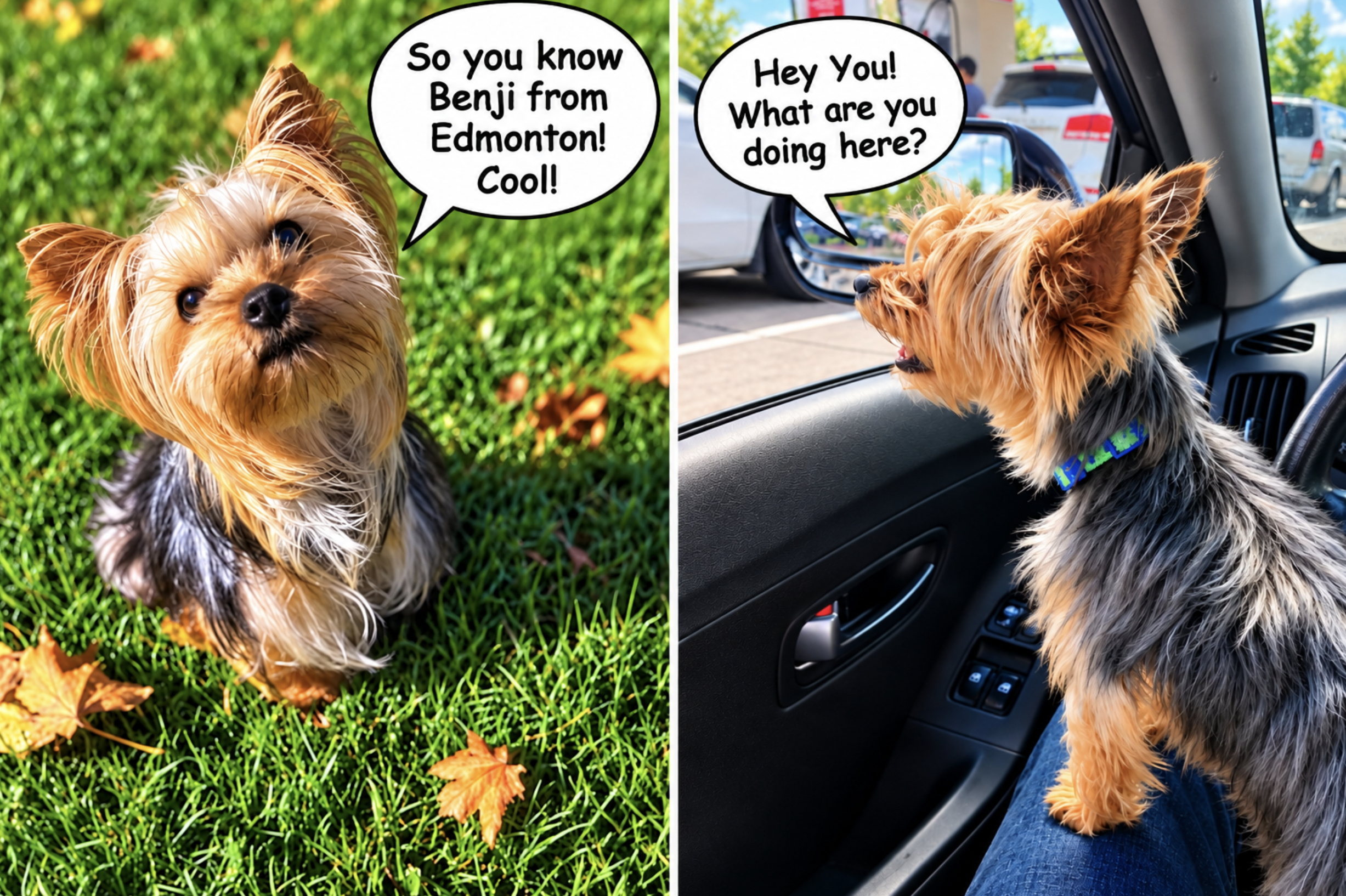
While wandering around Port Perry, I spotted a woman walking her Yorkie. Well, I couldn’t resist. I went over, introduced myself and struck up a conversation.
She told me her name and introduced me to her four-legged companion, Maggie.
What a cutie!
Naturally, I had to get a photograph.
Later, I decided to have a little fun by combining two separate photographs and adding speech bubbles.
Maggie, meet Benji. Benji, meet Maggie.
Something tells me they’d have plenty to bark about.
THE END
All good things come to an end, they say.
On Saturday, October 3, 2026, I returned my rental vehicle at Pearson Airport in Toronto [put on 6,600 km], made my way through security and plunked myself down in a chair. Exhausted.
What a trip. What an adventure.
I’d covered a lot of ground, both on the highway and in my head.
I’d done two interviews, been interviewed twice myself, reconnected with old friends — some perhaps for the last time — and renewed my love affair with Sugarloaf Mountain in Campbellton.
I’d admired more antique cars, played some chess, met some wonderful people and enjoyed the kind of hospitality that reminds you there are still plenty of good folks in this world.
I’d also put in a good word for having a church gymnasium named after Don Hume, our old soccer coach — a man who helped shape the lives of so many young fellows, including mine. Recognition long overdue, in my opinion.
And I’d handed out a few gifts along the way. Nothing extravagant. Just little things to let people know they hadn’t been forgotten.
Funny how something so small can mean so much.
Before leaving Ontario, I phoned my friend Bryne MacIntyre to say goodbye. During our conversation, he made a rather unusual observation.
“You’re like a disciple,” he said, “going here and there helping people.”
A disciple?
Well, that’s a new one. LOL.
But I appreciated the sentiment.
Looking back, I suppose this journey was about more than visiting old friends and familiar places. It was about reconnecting with my past, appreciating the present and recognizing that the future isn’t guaranteed.
Not for me. Not for anyone.
Some of the people I visited are getting along in years. So am I. We all know what that means, even if we don’t particularly care to talk about it.
There were handshakes, hugs, laughter and stories about the good old days. And sometimes, as I drove away, I wondered whether we’d ever see each other again.
That’s a sobering thought.
But it also makes those visits more meaningful.
One thing I’ve learned over the years is that you can’t go back in time, but you can go back to the places where time once stood still for you.
And sometimes, if you’re lucky, a few of the people who made those places special are still there.
The clock’s ticking for all of us.
There will come a day when I won’t be able to travel anymore, except perhaps from my bedroom to a rocking chair.
And you know something? I’m okay with that.
I’ll have some wonderful memories to keep me company. A little soft music, a few vodka coolers and perhaps a smile as I remember some of the crazy things I’ve done over the years.
I’ve had a good run.
And if, somewhere along the way, I’ve helped someone through a difficult time, brought a smile to a face, or made this world just a tiny bit better than I found it, then I’ve accomplished something worthwhile.
Knowing I made a difference, however small, will do just fine.
Because when all is said and done, it’s not how far you’ve travelled that matters.
It’s what you’ve left behind.
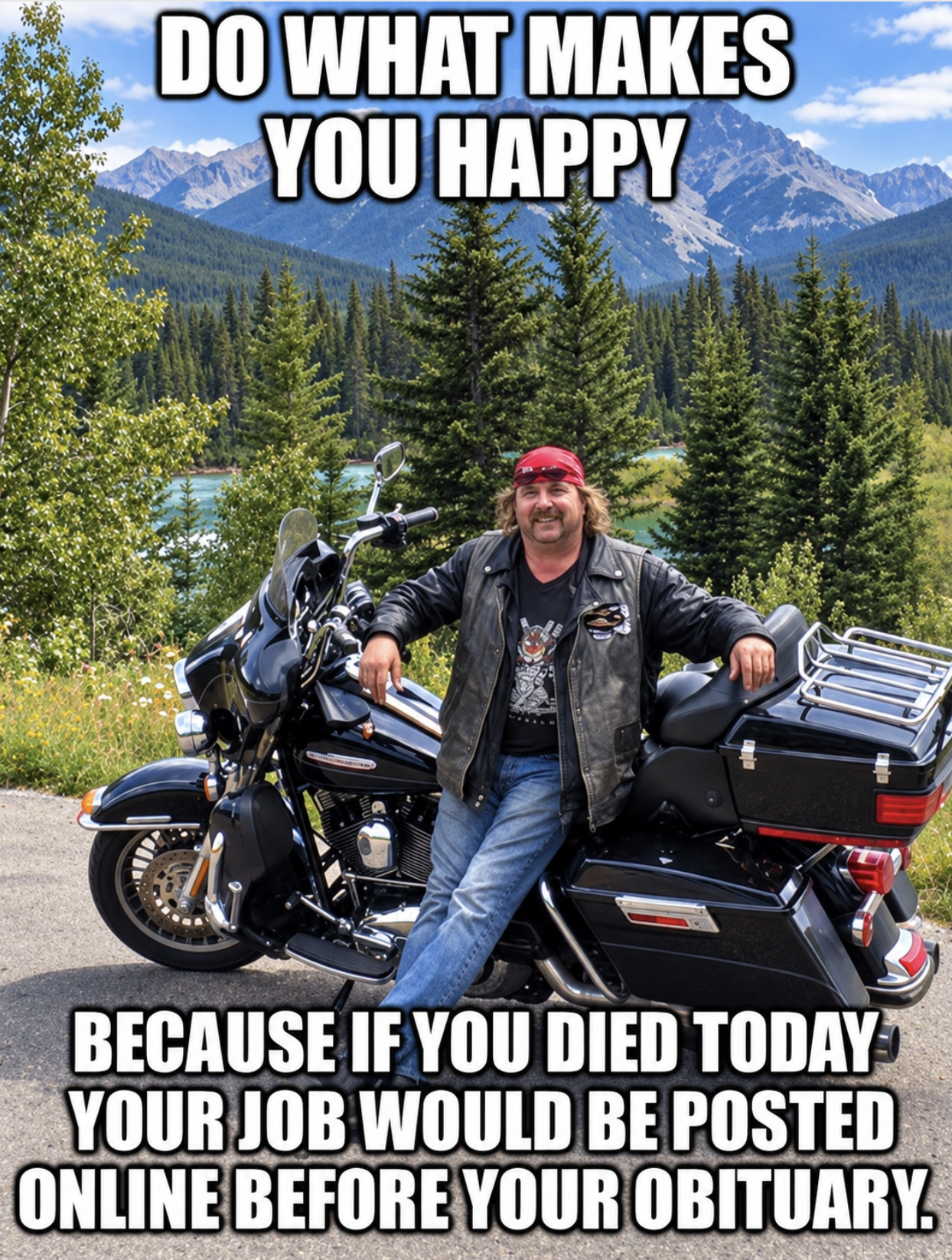
And on that note, I’ll leave you with one final thought.
HOME AGAIN AND IN THE DOGHOUSE


I never expected to receive a mention but thank you for that.
I’m doing just excellent, having finished 25 rounds of radiation following surgery to remove the Neourendocrine Carcinoid from my upper left thigh. They’re sure they got it all and now my wonderful life continues.
LikeLike
Good morning 🙂
Well thank you for the memories down the lane of your trip down East. Very interesting and with non dementia memories, remembering your friends and where you’ve been, although as you probably know my friend, dementia usually starts with short term memory and easily remembering the past hahahaha you are a special character. Hoping you keep in touch with your special friends until you can’t remember them anymore.
Irene
P.S. Waiting for part 3 😉
LikeLike
Thoroughly enjoyed this.
LikeLike